
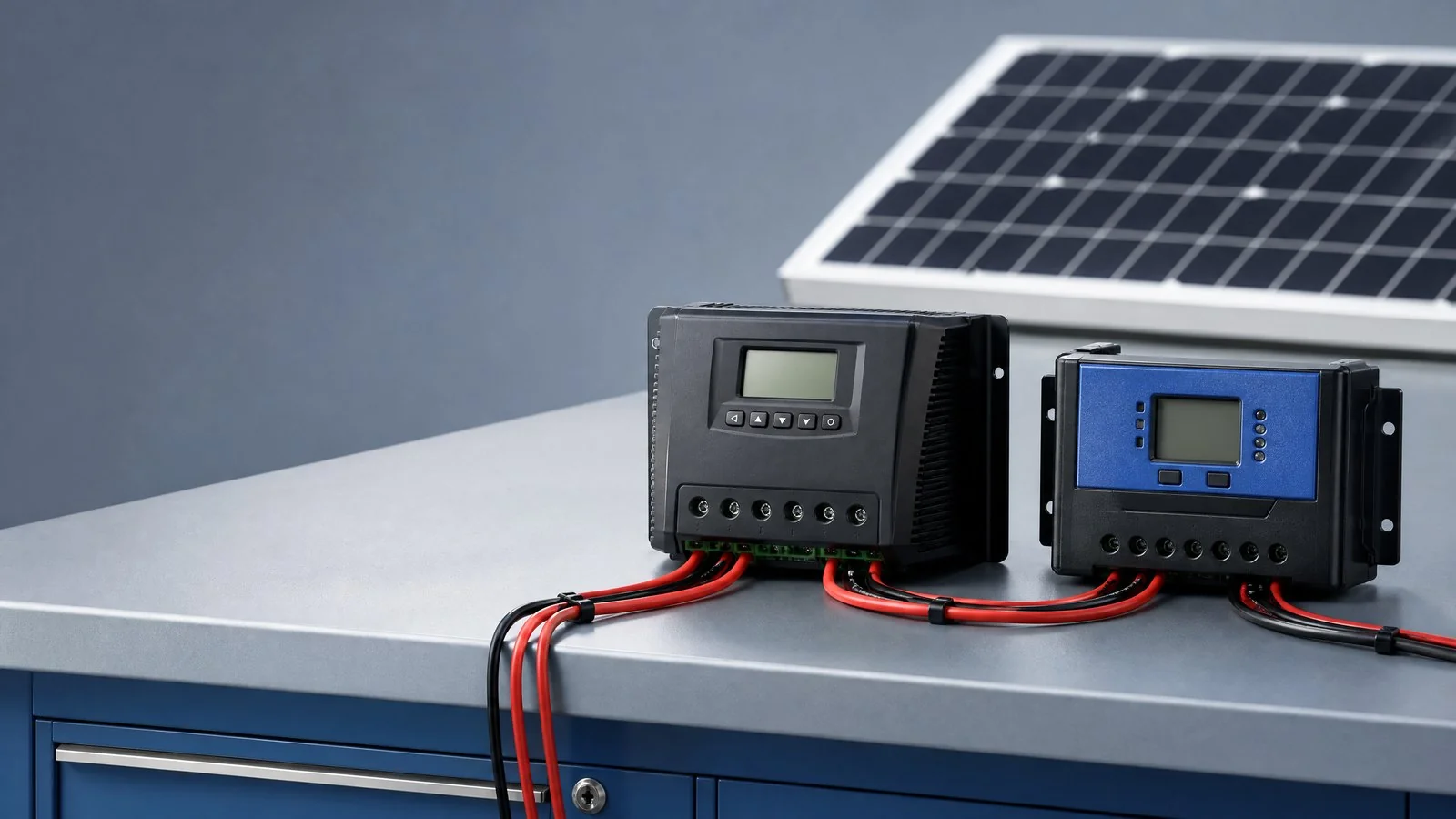
Why Your Solar Charge Controller Choice Matters
The debate of MPPT vs PWM charge controller technology is one of the most important decisions you will make when designing a solar power system. The solar charge controller sits between your photovoltaic array and your battery bank, acting as the brain that regulates energy flow, prevents overcharging, and protects your investment in energy storage. Choose the wrong type and you could lose 20 to 30 percent of your daily energy harvest, a penalty that compounds over the 25-year lifespan of your solar panels. According to the U.S. National Renewable Energy Laboratory (NREL), charge controller selection is the second most impactful component decision after panel efficiency, yet it is frequently overlooked by system designers focused only on wattage ratings.
Whether you are building an off-grid cabin, a residential backup system, or a commercial solar installation, understanding how maximum power point tracking differs from pulse width modulation will help you optimize both performance and budget. This guide breaks down the technical differences, compares real-world energy harvest data, and provides clear recommendations based on system size and application. By the end, you will know exactly which controller technology delivers the best return on investment for your specific solar power regulation needs and avoid the costly mistake of undersizing or mismatching this critical component.
Understanding PWM Charge Controllers
Pulse Width Modulation (PWM) charge controllers represent the original and simplest approach to solar power regulation. A PWM controller connects the solar panel array directly to the battery bank and uses a rapid on-off switching mechanism to taper the charging current as the battery reaches full capacity. When the battery voltage is low, the switch stays on almost continuously, allowing maximum current to flow. As the battery charges and its voltage rises, the controller gradually reduces the duty cycle of the pulse, effectively limiting the charge to a trickle that maintains the battery without overcharging it.
The fundamental limitation of PWM technology is that it pulls the solar panel voltage down to match the battery voltage. If you have a 36-cell solar panel designed to operate at its maximum power point of around 18 volts, but your 12V battery bank sits at 13.5 volts, the PWM controller forces the panel to operate at 13.5 volts instead. This mismatch means you are losing the power that exists between the panel maximum power voltage and the battery voltage. Despite this efficiency penalty, PWM controllers remain popular for small, budget-sensitive systems because they are affordable, typically priced between $20 and $50, and remarkably reliable with few electronic components that can fail.
PWM controllers are best suited for small solar systems under 200 watts, such as garden lighting, small RV setups, or trickle-charging a single battery. They work most efficiently when the solar panel nominal voltage matches the battery bank voltage, for example pairing a 12V nominal panel with a 12V battery. For these simple applications, the energy losses from voltage mismatch are minimal, and the cost savings over an MPPT charge controller can be justified. However, as system size grows or when using higher-voltage panels, the limitations of PWM become increasingly costly.
Understanding MPPT Charge Controllers
Maximum Power Point Tracking (MPPT) charge controllers represent a fundamentally different and more sophisticated approach to solar power regulation. Rather than forcing the solar panel to operate at the battery voltage, an MPPT controller acts as a DC-to-DC converter that decouples the panel voltage from the battery voltage. It continuously scans the current-voltage curve of the solar array, calculates the point where panel voltage multiplied by current produces the maximum power, and then converts that power to the correct voltage and current needed to charge the battery efficiently.
This tracking process happens dozens of times per second, allowing the controller to adjust to changing irradiance levels, temperature shifts, and partial shading conditions in real time. The result is a significant efficiency gain: MPPT controllers typically convert 95 to 99 percent of available panel power into usable charging current, compared to the 70 to 80 percent effective conversion rate of PWM controllers. According to data from Sandia National Laboratories, MPPT controllers deliver 20 to 30 percent more energy harvest than PWM controllers in typical off-grid systems, with even greater gains during cold, clear mornings when panel voltage is elevated above rated levels.
Beyond raw efficiency, MPPT controllers offer advanced features that PWM units cannot match. These include support for higher-voltage panel strings, allowing you to wire panels in series to reduce wire losses over long cable runs, multi-stage battery charging profiles that extend battery life, and built-in monitoring with LCD displays or Bluetooth connectivity that report real-time production data. The trade-off is cost: MPPT controllers range from $100 for entry-level 30-amp units to $500 or more for high-capacity 60-amp and 100-amp models with advanced communication interfaces and data logging capabilities.
Head-to-Head Comparison: 8 Critical Factors
To make an informed decision in the MPPT vs PWM debate, you need to evaluate both technologies across the factors that matter most for your solar installation. The following comparison summarizes eight critical dimensions. | Factor | PWM Controller | MPPT Controller | | Conversion Efficiency | 70-80% | 95-99% | | Price Range | $20-$50 | $100-$500 | | System Voltage Flexibility | Panel V must match battery V | Any panel V to any battery V | | Panel String Configuration | Parallel only | Series or parallel | | Low-Light Performance | Poor | Excellent | | Battery Compatibility | Lead-acid optimized | Lead-acid, LiFePO4, custom | | Monitoring Features | Basic LED indicators | LCD, Bluetooth, data logging | | Expected Lifespan | 10-15 years | 10-15 years |
Efficiency is the single most consequential difference. A PWM controller operating a 12V battery from a 12V nominal panel achieves roughly 70 to 80 percent effective efficiency because it cannot extract the power available above the battery voltage. An MPPT controller, by contrast, converts that same panel full output with only 1 to 5 percent conversion loss, yielding 95 to 99 percent overall efficiency. This gap translates directly into more amp-hours stored per day and faster battery recharge times, which is particularly valuable during short winter days or periods of low irradiance.
System voltage flexibility and panel string configuration are equally important for larger installations. PWM controllers require the solar panel nominal voltage to match the battery bank voltage, which limits you to parallel wiring and thicker, more expensive cabling for long runs. MPPT controllers accept high-voltage series strings, often up to 150V DC on 60-amp models, and step the voltage down to charge 12V, 24V, 36V, or 48V battery banks. This capability lets you use standardized residential panels and reduce wire gauge, cutting both material costs and line losses significantly on larger solar power regulation systems.
Real-World Energy Harvest Comparison
Let us quantify the MPPT advantage with a concrete example. Consider a 3kW off-grid solar system using six 500W monocrystalline panels, a 48V LiFePO4 battery bank, and an average of 5 peak sun hours per day. With a PWM controller, the panels are forced to operate at the battery voltage, and the effective energy harvest after controller losses and wiring drops to approximately 9.6 kWh per day (3kW multiplied by 5 hours multiplied by 64 percent overall efficiency). With an MPPT controller, the same system harvests about 13.5 kWh per day (3kW multiplied by 5 hours multiplied by 90 percent overall efficiency), a difference of 3.9 kWh every single day.
Over a full year, that extra 3.9 kWh per day accumulates to 1,424 kWh of additional energy. At an average off-grid electricity value of $0.25 per kWh, the MPPT controller generates $356 in additional energy value annually. If the MPPT controller costs $300 more than an equivalent PWM unit, the simple payback period is under 11 months. Over the controller 10 to 15-year lifespan, the net energy gain is worth $3,500 to $5,300, more than ten times the initial price difference and a compelling return on investment.
The ROI calculation becomes even more favorable in cold climates and during winter months. Solar panels produce higher voltage in cold conditions, sometimes 25 percent above their rated voltage, which means the gap between the panel maximum power point and the battery voltage widens. MPPT controllers capture this surplus voltage as additional current, while PWM controllers cannot. Bloomberg NEF research confirms that in temperate climates with significant seasonal temperature variation, MPPT controllers can deliver up to 40 percent more energy than PWM during winter months, dramatically shortening the payback period and improving year-round system reliability.
Which Charge Controller Is Right for Your System?
For small systems under 200 watts, such as a single 100W panel charging a 12V battery for garden lighting or a small backup power supply, a PWM charge controller is usually the right choice. At this scale, the energy losses from voltage mismatch are small in absolute terms, perhaps 10 to 15 watt-hours per day, and the $20 to $50 price of a PWM unit is hard to justify replacing with a $100+ MPPT controller. The simplicity of PWM also means fewer failure points, which matters for unattended installations in remote locations.
For medium systems between 200 watts and 1 kilowatt, the decision depends on your panel voltage and climate. If you are using standard 12V nominal panels matched to a 12V battery in a warm climate, a PWM controller may still be acceptable. However, if you are using higher-voltage 24V panels, operating in a cold climate, or charging a LiFePO4 battery that benefits from precise multi-stage charging, an MPPT controller is worth the investment. A 30A MPPT controller in the $100 to $150 range will typically pay for itself within the first year through additional energy harvest.
For large systems above 1 kilowatt, off-grid cabins, and RV or marine applications with high-voltage panel arrays, MPPT is often the appropriate option. The ability to wire panels in series for higher voltage can reduce wire losses and allow smaller gauge cabling, which is especially valuable in RV and marine installations where space and weight are constrained. For a HousePlus controller inquiry, confirm the applicable model, electrical specifications and destination-specific compliance documentation before purchase.
Conclusion: Maximizing Your Solar Investment
The MPPT vs PWM charge controller decision ultimately comes down to system size, panel voltage, climate, and budget. PWM controllers remain a sensible, cost-effective choice for small systems under 200 watts where panel and battery voltages are matched and energy losses are minimal in absolute terms. For everything else, including medium and large systems, high-voltage panel strings, cold-climate installations, and LiFePO4 battery banks, MPPT technology delivers 20 to 30 percent more energy harvest and pays for itself within the first one to two years of operation.
At HousePlus, our 20,000-square-meter factory in Zhongshan, Guangdong produces a full range of solar charge controllers, from affordable 20A PWM units to high-efficiency 60A MPPT controllers with 99 percent tracking efficiency. Every controller carries CE, FCC, and RoHS certifications and is backed by our ISO 9001:2015 quality management system. Contact us at jack@houseplus-ch.com or +86-155-7811-9543 to discuss your system requirements and request a wholesale quotation. Our engineering team will help you select the right controller technology for your specific application and budget, ensuring you maximize every watt your solar panels produce.
Request a Wholesale Quote from HousePlus
Contact our team to discuss product requirements, OEM/ODM capabilities, applicable documentation and quotation terms.
Contact HousePlus