
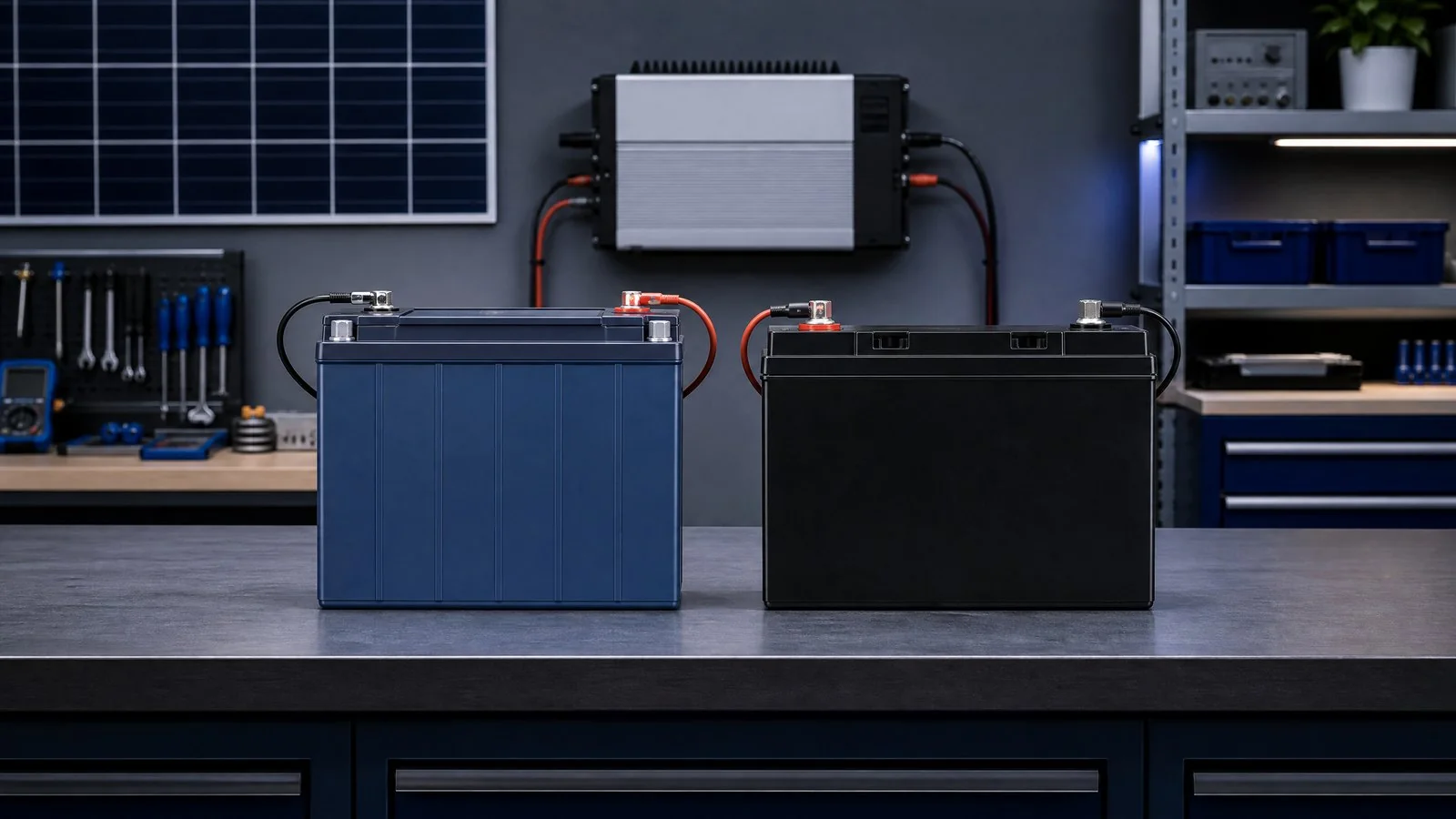
Why Battery Choice Is Critical for Solar Energy Storage
When designing a solar energy storage system, the battery you select will have a greater impact on long-term performance, reliability, and return on investment than any other single component. The debate between LiFePO4 vs lead acid battery technology has intensified as solar installers, off-grid homeowners, and commercial project developers seek storage that can deliver thousands of cycles without degradation. According to the U.S. Department of Energy energy storage database, battery storage capacity in solar installations has grown more than tenfold over the past decade, and lithium-based chemistries now dominate new deployments. Making the right choice early prevents costly replacements and ensures your system delivers consistent power year after year.
Solar panels generate electricity only when the sun shines, which means the battery bank is the heart of any off-grid or hybrid system. A poorly matched battery will throttle your energy harvest, shorten system lifespan, and inflate your total cost of ownership. This comprehensive comparison examines lithium iron phosphate battery technology against traditional lead-acid chemistry across ten critical metrics, including cycle life, depth of discharge, energy density, charge efficiency, operating temperature range, maintenance requirements, safety, environmental impact, weight, and both upfront and long-term cost. By the end, you will have a clear, data-driven answer to which deep cycle battery technology best serves your solar energy storage needs.
Understanding LiFePO4 Battery Technology
LiFePO4, shorthand for lithium iron phosphate, is a lithium-ion chemistry that uses LiFePO4 as the cathode material. Unlike the cobalt-based lithium chemistries found in consumer electronics, lithium iron phosphate battery cells employ a robust olivine crystal structure that bonds oxygen atoms tightly, virtually eliminating the risk of thermal runaway. This structural stability is why LiFePO4 has become the preferred chemistry for solar energy storage, where batteries are charged and discharged daily in varying ambient conditions. Each prismatic cell typically operates at a nominal 3.2 volts, and a standard 12V battery pack comprises four cells in series managed by an internal Battery Management System (BMS).
The safety advantages of LiFePO4 are well documented by independent testing bodies such as TUV Rheinland and UL. The chemistry tolerates temperatures up to 270 degrees Celsius before decomposition begins, compared with approximately 150 degrees Celsius for nickel manganese cobalt (NMC) cells. Thermal stability translates into real-world safety: a LiFePO4 battery will not spontaneously combust even if punctured, overcharged, or short-circuited, provided the BMS is functioning. Energy density typically ranges from 90 to 160 watt-hours per kilogram, meaning a 100Ah LiFePO4 battery weighs roughly 12 to 14 kilograms while delivering the same nominal capacity as a lead-acid battery nearly three times heavier. This combination of safety, light weight, and high usable capacity makes LiFePO4 ideal for solar battery storage.
Beyond chemistry and safety, LiFePO4 batteries offer practical advantages that directly benefit solar system operators. The flat discharge voltage curve means the battery delivers near-constant voltage throughout the cycle, protecting sensitive loads and inverters from voltage sag. Charge efficiency exceeds 95 percent, so nearly every watt your solar panels produce is stored rather than lost as heat during charging. The internal BMS actively balances cells, prevents over-discharge, and provides real-time state-of-charge data via Bluetooth or RS485 communication, giving system owners unprecedented visibility into their solar energy storage health.
Understanding Lead-Acid Battery Technology
Lead-acid battery technology has served as the workhorse of deep cycle battery applications for more than 160 years, and its maturity is both its greatest strength and its most significant limitation. A lead-acid cell consists of lead dioxide positive plates, sponge lead negative plates, and a sulfuric acid electrolyte. Three subtypes dominate the solar market: flooded lead-acid (FLA), absorbed glass mat (AGM), and gel batteries. Flooded batteries offer the lowest purchase price but require regular distilled-water refilling and venting of hydrogen gas. AGM batteries suspend the electrolyte in fiberglass mats, making them spill-proof and maintenance-free, while gel batteries use a silica-gelled electrolyte that resists deep discharge damage better than AGM.
The appeal of lead-acid lies in its proven reliability and low upfront cost. Manufacturers have refined the chemistry over decades, and the supply chain is globally established, so spare parts and recycling infrastructure are ubiquitous. A 12V 100Ah AGM battery can be purchased for roughly one-third the price of an equivalent LiFePO4 battery, which explains why budget-conscious installers and developing-market projects still default to lead-acid. The International Renewable Energy Agency (IRENA) notes that lead-acid remains the most widely deployed battery chemistry in off-grid solar across Sub-Saharan Africa and South Asia.
However, lead-acid limitations become apparent over the system lifecycle. The chemistry suffers from low depth of discharge, typically recommended at 50 percent or less to preserve cycle life. Sulfation, a process where lead sulfate crystals accumulate on plates during partial charging, progressively reduces capacity until the battery fails. Energy density is low, at 30 to 50 watt-hours per kilogram, so a 100Ah lead-acid battery weighs 28 to 32 kilograms, adding structural and installation burden. Charge efficiency hovers between 70 and 85 percent, meaning 15 to 30 percent of solar energy is wasted as heat during charging. These constraints drive the growing lithium battery vs lead acid migration in modern solar projects.
Head-to-Head Comparison: 10 Key Metrics
The most rigorous way to evaluate LiFePO4 vs lead acid battery performance is to compare them metric by metric using data from IEC 62660 testing and manufacturer datasheets. Below is a structured comparison across the ten metrics that matter most to solar system designers: | Metric | LiFePO4 Battery | Lead-Acid Battery | |---|---|---| | Cycle Life | 2,000–7,000 cycles | 300–500 cycles | | Depth of Discharge (DoD) | 80–100% | 50% recommended | | Energy Density | 90–160 Wh/kg | 30–50 Wh/kg | | Charge Efficiency | 95–98% | 70–85% | | Operating Temperature | -20°C to 60°C | -10°C to 45°C | | Maintenance | None (sealed) | Periodic (flooded) | | Safety | Thermal runaway >270°C | Hydrogen gas venting | | Environmental Impact | Non-toxic, recyclable | Lead and acid toxicity | | Weight (100Ah 12V) | 12–14 kg | 28–32 kg | | Upfront Cost | Higher | Lower |
Cycle life is the single most decisive metric. A quality LiFePO4 battery rated at 6,000 cycles at 80 percent DoD will deliver roughly 16 years of daily cycling in a solar application. By contrast, a deep cycle lead-acid battery managed at 50 percent DoD typically survives 300 to 500 cycles, or one to two years in daily-cycling service, before capacity drops below 80 percent of rated capacity. This means you would replace a lead-acid bank 8 to 12 times over the lifespan of a single LiFePO4 bank, a replacement burden that dwarfs any upfront savings.
Depth of discharge compounds the cycle-life gap. Because LiFePO4 safely supports 80 to 100 percent DoD, a 100Ah lithium battery yields 80 to 100 amp-hours of usable energy. A lead-acid battery limited to 50 percent DoD delivers only 50 amp-hours from the same 100Ah rating, so you must buy twice the nominal capacity to match usable energy. Energy density and weight differences further tilt the balance: at 90 to 160 Wh/kg versus 30 to 50 Wh/kg, LiFePO4 packs the same energy into roughly one-quarter the mass, reducing shipping costs, rack loading, and structural reinforcement requirements. Charge efficiency of 95 to 98 percent for LiFePO4 means solar panels spend less energy overcoming internal resistance, allowing faster full-charge recovery after cloudy periods.
Operating temperature range, maintenance, safety, and environmental impact round out the comparison. LiFePO4 operates from minus 20 to 60 degrees Celsius with no maintenance, while flooded lead-acid requires regular watering and is limited to minus 10 to 45 degrees Celsius. Safety is a clear lithium advantage: LiFePO4 cells do not vent explosive hydrogen gas and remain stable well beyond the temperatures that cause lead-acid thermal runaway. Environmentally, LiFePO4 contains no toxic lead or corrosive acid, and although lead-acid recycling rates exceed 99 percent in mature markets, the extraction and smelting of lead carry significant occupational and ecological risks documented by the World Health Organization.
Total Cost of Ownership: The Hidden Economics
Upfront cost is the most common reason buyers initially choose lead-acid, but total cost of ownership (TCO) over a ten-year horizon tells a very different story. Consider a 5kWh solar energy storage requirement for an off-grid home. A LiFePO4 battery delivering 5kWh of usable energy costs approximately $1,200 to $1,800 and lasts 10-plus years. To obtain the same 5kWh of usable energy from lead-acid, you must purchase a 10kWh bank, because of the 50 percent DoD limitation, costing $1,000 to $1,400 upfront. At first glance the lead-acid option appears cheaper, but the picture reverses once replacement cycles enter the calculation.
At 300 to 500 cycles per lead-acid bank, a daily-cycling solar system consumes one bank every 10 to 16 months. Over ten years, that is 7 to 12 replacement sets at $1,000 to $1,400 each, bringing the lead-acid TCO to $7,000 to $16,800. The single LiFePO4 battery, still operating at 80-plus percent capacity at year 10, costs nothing in replacements. The table below summarizes the ten-year TCO for equivalent 5kWh usable energy: | Cost Factor (10-Year, 5kWh Usable) | LiFePO4 | Lead-Acid | |---|---|---| | Upfront Purchase | $1,200–$1,800 | $1,000–$1,400 | | Replacements Needed | 0 | 7–12 sets | | Replacement Cost | $0 | $7,000–$16,800 | | Maintenance Labor | $0 | $500–$1,000 | | Total Cost of Ownership | $1,200–$1,800 | $8,500–$19,200 |
Even when you factor in a possible mid-life BMS repair or the slight capacity fade of LiFePO4, the lithium battery remains 4 to 10 times cheaper per delivered kilowatt-hour over its service life. Industry analyses by BloombergNEF and the National Renewable Energy Laboratory (NREL) confirm that levelized cost of storage (LCOS) for lithium chemistries fell below lead-acid between 2020 and 2022 for daily-cycling applications, and the gap continues to widen as lithium cell prices decline. For any solar project with a horizon beyond three years, LiFePO4 is the economically rational choice.
Which Battery Type Is Right for Your Solar System?
Application context should guide your final decision. For residential off-grid solar systems, LiFePO4 is overwhelmingly the best choice: the combination of high DoD, zero maintenance, and 10-year cycle life aligns perfectly with home energy needs and the desire for hands-off reliability. Homeowners avoid the chore of watering batteries, eliminate hydrogen gas venting inside living spaces, and recover more of their solar harvest thanks to 95-percent-plus charge efficiency. A single 12V 200Ah LiFePO4 battery typically powers a small off-grid cabin for a decade without intervention.
Commercial and industrial solar installations benefit even more from lithium, because downtime and replacement labor costs are magnified at scale. Telecom base stations, which require 48V backup banks cycled daily, have migrated almost entirely to LiFePO4 for its predictable capacity and remote-monitoring BMS. For RV and marine applications, the weight savings are decisive: replacing a 30kg lead-acid house battery with a 13kg LiFePO4 unit of equal usable capacity frees payload, improves fuel efficiency, and simplifies installation. The one scenario where lead-acid still makes sense is ultra-short-term or ultra-budget projects with a horizon under two years, where the lowest upfront cost matters more than longevity, or where an existing lead-acid charging infrastructure cannot be easily adapted to lithium charging profiles.
Conclusion: The Future of Solar Storage Is Lithium
The LiFePO4 vs lead acid battery comparison resolves decisively in favor of lithium iron phosphate for nearly every modern solar energy storage application. Across cycle life, depth of discharge, energy density, charge efficiency, temperature range, maintenance, safety, environmental impact, weight, and total cost of ownership, LiFePO4 outperforms lead-acid by margins that grow wider the longer you operate the system. A 6,000-cycle LiFePO4 bank delivers a ten-year TCO that is a fraction of the repeated replacement costs inherent to lead-acid, and it does so with zero maintenance and superior safety.
As lithium cell prices continue their downward trend and solar adoption accelerates globally, lead-acid remaining cost advantage is disappearing. Whether you are designing a residential off-grid system, a commercial microgrid, or a mobile solar application, HousePlus can supply CE-certified LiFePO4 batteries with built-in BMS protection, backed by a 20,000-square-meter ISO 9001:2015 manufacturing facility and 500 skilled employees in Zhongshan, Guangdong. Contact Jack and the HousePlus team at jack@houseplus-ch.com or +86-155-7811-9543 to request a datasheet, pricing, and samples for your next solar storage project.
Request a Wholesale Quote from HousePlus
Contact our team to discuss product requirements, OEM/ODM capabilities, applicable documentation and quotation terms.
Contact HousePlus