
Understanding Solar Cell Technologies: A 2026 Overview
The debate over monocrystalline vs polycrystalline solar panels has defined the solar industry for over a decade, but in 2026 the conversation has evolved. PERC solar panel technology, once a premium upgrade, is now the default architecture for most new monocrystalline production lines, while polycrystalline panels have retreated to niche budget segments. For B2B buyers and project developers, understanding the technical and economic trade-offs between these cell technologies is essential to maximizing energy yield per dollar and per square meter.
Solar panel efficiency is determined by how effectively a cell converts sunlight into electricity, and that conversion is governed by crystal structure, surface passivation, and light-trapping design. According to the National Renewable Energy Laboratory (NREL), commercial crystalline silicon module efficiencies now range from 15% at the low end to over 23% at the high end, a spread that has enormous implications for project sizing, balance-of-system costs, and lifetime energy production. This guide compares the three dominant technologies head to head so you can make a data-driven decision for your next procurement cycle.
Monocrystalline Solar Panels: The Efficiency Leader
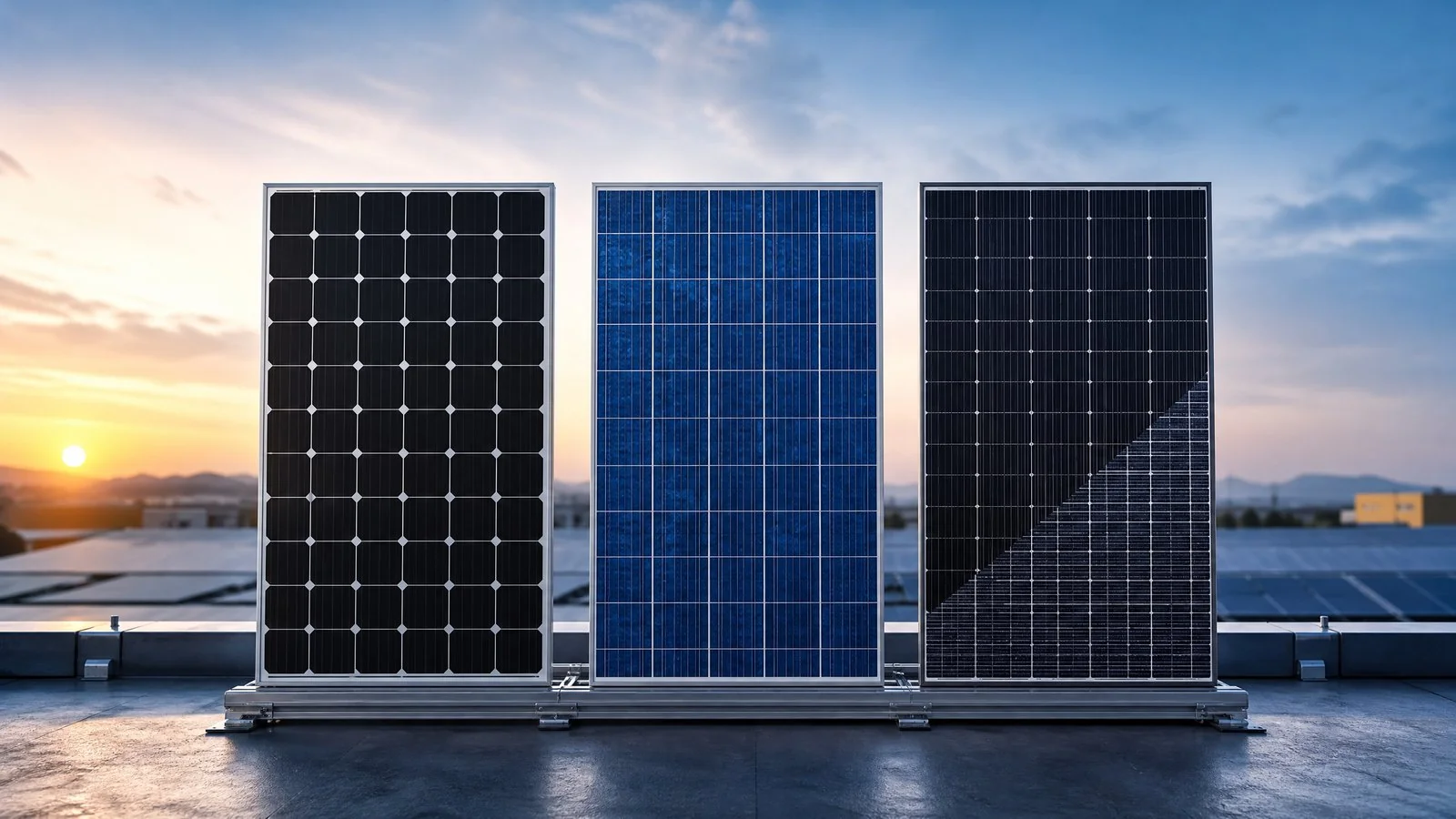
Monocrystalline solar panels are made from a single, continuous crystal of silicon, grown using the Czochralski process into a cylindrical ingot that is then sliced into wafers. The uniform crystal lattice allows electrons to move with minimal resistance, which is why monocrystalline solar panels achieve the highest commercial efficiencies of any silicon-based technology, typically 20 to 23% at the module level. The cells are recognizable by their black, octagonal shape and uniform dark appearance, a result of the corners being cut from the round wafer to pack more cells into a module.
The manufacturing process for monocrystalline silicon is energy-intensive and technically demanding. It requires precise temperature control during crystal growth and produces more silicon waste than polycrystalline casting, which historically made mono panels 10 to 20% more expensive. However, economies of scale and the Diamond Wire Sawing revolution have closed that gap significantly. By 2026, monocrystalline wafers account for over 95% of new cell production capacity worldwide, as reported by the International Energy Agency (IEA), because the efficiency advantage translates into lower balance-of-system costs per watt.
The key advantages of monocrystalline panels are higher efficiency, better performance in low-light and high-temperature conditions, and a longer effective lifespan due to slower degradation. The trade-offs are a higher per-watt price than polycrystalline (though the gap has narrowed to under 5%) and a more complex manufacturing process that limits the number of true producers. For any project where roof or land area is constrained, or where maximizing yield per panel is critical, monocrystalline is the clear choice.
Polycrystalline Solar Panels: The Budget Option
Polycrystalline solar panels are manufactured by melting raw silicon in a quartz crucible and casting it into a square block, a process that allows many crystals to form simultaneously rather than growing a single crystal. The resulting multi-crystalline structure is visible as a speckled, bluish surface with clearly defined grain boundaries. Because the casting process is simpler, faster, and wastes less silicon than Czochralski growth, polycrystalline solar panels have historically been the cheapest option on the market, with module efficiencies ranging from 15 to 18%.
The grain boundaries between crystals are also the root of polycrystalline's efficiency limitation. These boundaries create recombination sites where electrons are lost as heat rather than contributing to current, which caps the practical efficiency ceiling below that of monocrystalline. Polycrystalline panels also tend to have a worse temperature coefficient, meaning their output drops more steeply as cell temperature rises, which matters in hot-climate installations. Despite this, they remain viable for applications where space is abundant and upfront cost is the primary driver.
In 2026, polycrystalline panels occupy a shrinking but real market segment. Major manufacturers have largely converted their production lines to monocrystalline, which means polycrystalline supply is tightening even as prices remain low. For buyers sourcing very large ground-mount projects in regions with abundant cheap land, polycrystalline can still deliver the lowest levelized cost of energy (LCOE). However, buyers should weigh the risk of supply scarcity and slightly faster degradation against the upfront savings, and verify that the manufacturer still supports the product line with full warranty coverage.
PERC Solar Panel Technology: The Modern Standard
PERC stands for Passivated Emitter Rear Contact, and it is not a separate cell material but an architectural enhancement applied to monocrystalline (and historically polycrystalline) cells. In a standard cell, some long-wavelength (red) light passes straight through the rear silicon without being absorbed. A PERC cell adds a dielectric passivation layer with a reflective rear surface that bounces unabsorbed light back into the silicon for a second absorption pass, while simultaneously reducing electron recombination at the rear surface. The result is a measurable efficiency gain of 1 to 3 percentage points over standard monocrystalline cells.
PERC solar panel technology has become the industry default for a compelling reason: it delivers higher efficiency with only a modest increase in manufacturing cost. The additional passivation and laser-opening steps add roughly 3 to 5% to cell production cost, but the efficiency gain increases the power output of each panel by 5 to 8%, improving the cost-per-watt ratio. According to Fraunhofer ISE, PERC cells accounted for over 80% of global cell production by 2025, effectively making standard (non-PERC) monocrystalline cells a legacy product. When a supplier in 2026 quotes "monocrystalline panels," they are almost certainly quoting PERC.
For B2B buyers, the practical implication is that PERC should be the baseline expectation, not a premium upgrade. If a supplier offers non-PERC monocrystalline panels at a deep discount, scrutinize the efficiency rating: it will likely be 18 to 20% rather than the 21 to 23% typical of PERC. The slight savings rarely justify the lower yield, especially in space-constrained or high-irradiance installations. Always confirm the cell architecture in the datasheet and request the flash-test report to verify that the PERC efficiency gain is actually reflected in shipped panels.
Head-to-Head Comparison: Efficiency, Cost, and Performance
To make an informed solar panel types comparison, buyers need specific, quantifiable data rather than marketing generalities. The table below consolidates the key performance and economic parameters for all three technologies, using 2026 market benchmarks verified against NREL and Fraunhofer ISE datasets. These figures represent typical commercial-grade modules; premium or budget variants may deviate.
Side-by-side comparison of monocrystalline, polycrystalline, and PERC solar panels (2026 benchmarks): | Parameter | Monocrystalline (Standard) | Monocrystalline PERC | Polycrystalline | |-----------|---------------------------|---------------------|-----------------| | Module efficiency | 18% to 20% | 21% to 23% | 15% to 18% | | Temperature coefficient | minus 0.38% / deg C | minus 0.34% / deg C | minus 0.40% / deg C | | Annual degradation | 0.55% / year | 0.45% / year | 0.60% / year | | Year-25 output guarantee | 80.0% | 84.8% | 80.0% | | Price per watt (FOB China) | USD 0.12 to 0.14 | USD 0.13 to 0.15 | USD 0.10 to 0.12 | | Best use case | Legacy stock | Most projects | Ultra-budget, ample space | The data reveals why PERC has displaced standard monocrystalline: for only a 1 to 2 cent per watt premium, PERC delivers 2 to 3 percentage points higher efficiency, a better temperature coefficient, and slower annual degradation.
Two metrics deserve special attention for B2B project modeling. First, the temperature coefficient matters enormously in hot climates: at a cell temperature of 65 degrees Celsius, a polycrystalline panel with a minus 0.40% coefficient loses roughly 13.6% of its rated output, while a PERC panel at minus 0.34% loses only 11.6%, a 2% yield advantage that compounds over 25 years. Second, the annual degradation rate determines lifetime energy harvest: a PERC panel degrading at 0.45% per year retains 84.8% of rated power at year 25, whereas a polycrystalline panel at 0.60% per year retains only about 80%, a cumulative difference that significantly impacts LCOE calculations for utility-scale projects.
Which Technology Is Best for Your Application?
For residential rooftop installations where roof area is the limiting factor, monocrystalline PERC panels are the unambiguous best choice. Their 21 to 23% efficiency generates more kilowatt-hours per square meter, allowing homeowners to hit their energy targets with fewer panels, less mounting hardware, and lower installation labor. The superior temperature coefficient also helps in attic-adjacent roof environments where panel temperatures routinely exceed 60 degrees Celsius. Polycrystalline panels are a false economy here, because the lower efficiency means buying more panels and more racking to achieve the same system size.
For commercial and utility-scale ground-mount projects, the decision hinges on land cost and LCOE. In regions where land is cheap and abundant, polycrystalline panels can still deliver the lowest upfront cost per watt, though buyers must factor in the faster degradation and reduced lifetime yield. In most cases, however, PERC monocrystalline wins on a 25-year LCOE basis because the higher efficiency reduces the number of panels, mounting structures, and DC cabling required, and the slower degradation preserves energy revenue in the back half of the project life. For off-grid and mobile applications, such as RVs, boats, and portable solar kits, monocrystalline PERC is strongly preferred because space and weight are at a premium and high-temperature performance matters.
In hot-climate regions such as the Middle East, Africa, and South Asia, the temperature coefficient should drive the decision. PERC panels maintain a clear advantage in desert and tropical environments where ambient temperatures push cell temperatures above 70 degrees Celsius. NREL field studies confirm that in climates with high solar irradiance and high ambient temperature, the real-world energy yield difference between PERC and polycrystalline can exceed 8% annually, far more than the datasheet efficiency gap suggests. Always model yield using local irradiance and temperature data, not just nameplate wattage.
Future Trends: TOPCon, HJT, and Beyond
While PERC dominates 2026 production, the industry is already transitioning to next-generation cell architectures. TOPCon (Tunnel Oxide Passivated Contact) cells achieve 24 to 25.5% efficiency by adding an ultra-thin tunnel oxide layer that further reduces recombination losses, and they are rapidly scaling because they can be manufactured on upgraded PERC lines with modest capital investment. Fraunhofer ISE projects that TOPCon will surpass PERC in global market share by 2027, making it the technology to specify for buyers planning multi-year procurement contracts.
Heterojunction (HJT) technology takes a different approach, sandwiching a thin crystalline silicon wafer between layers of amorphous silicon to achieve efficiencies above 25% and an exceptionally low temperature coefficient of minus 0.24% per degree Celsius. HJT panels are particularly promising for hot-climate and bifacial (double-sided) applications, but higher manufacturing costs have slowed mass adoption. Beyond HJT, perovskite-silicon tandem cells, which layer a perovskite material atop a silicon cell to capture different parts of the solar spectrum, have exceeded 33% efficiency in laboratory settings at NREL and are on track for commercial pilot lines by 2027 to 2028.
For B2B buyers, the practical takeaway is to future-proof procurement by requesting panels compatible with the technology roadmap. If you are signing a multi-year supply agreement, ask whether the manufacturer offers TOPCon as an upgrade path and whether the same module form factor will be maintained. The IEC is already developing updated test standards (IEC 61215 edition 2 and IEC 63209 for extended stress testing) to address the longer lifetimes and new degradation modes of these advanced cells, so confirm that any next-generation panels you source carry the latest certification revisions.
Conclusion: Making the Right Choice for Your Solar Project
The monocrystalline vs polycrystalline debate has largely been settled by market forces: monocrystalline PERC is the 2026 default, offering the best balance of efficiency, temperature performance, degradation rate, and cost per watt. Polycrystalline remains a viable budget option only for large ground-mount projects with abundant land and aggressive upfront cost targets. For the vast majority of residential, commercial, off-grid, and hot-climate applications, PERC monocrystalline panels deliver the lowest lifetime cost of energy and the highest yield per installed watt.
At HousePlus, our full solar panel lineup, from 100W portable modules to 550W utility-grade panels, uses PERC monocrystalline cells certified to IEC 61215, IEC 61730, CE, and RoHS standards. Whether you need a single pallet for a pilot project or full OEM branding for a distribution network, our engineering team can help you select the exact cell technology, wattage, and form factor for your application. Contact me at jack@houseplus-ch.com or call +86-155-7811-9543 to discuss your project, request flash-test reports, or arrange a sample shipment.
Request a Wholesale Quote from HousePlus
Contact our team to discuss product requirements, OEM/ODM capabilities, applicable documentation and quotation terms.
Contact HousePlus