
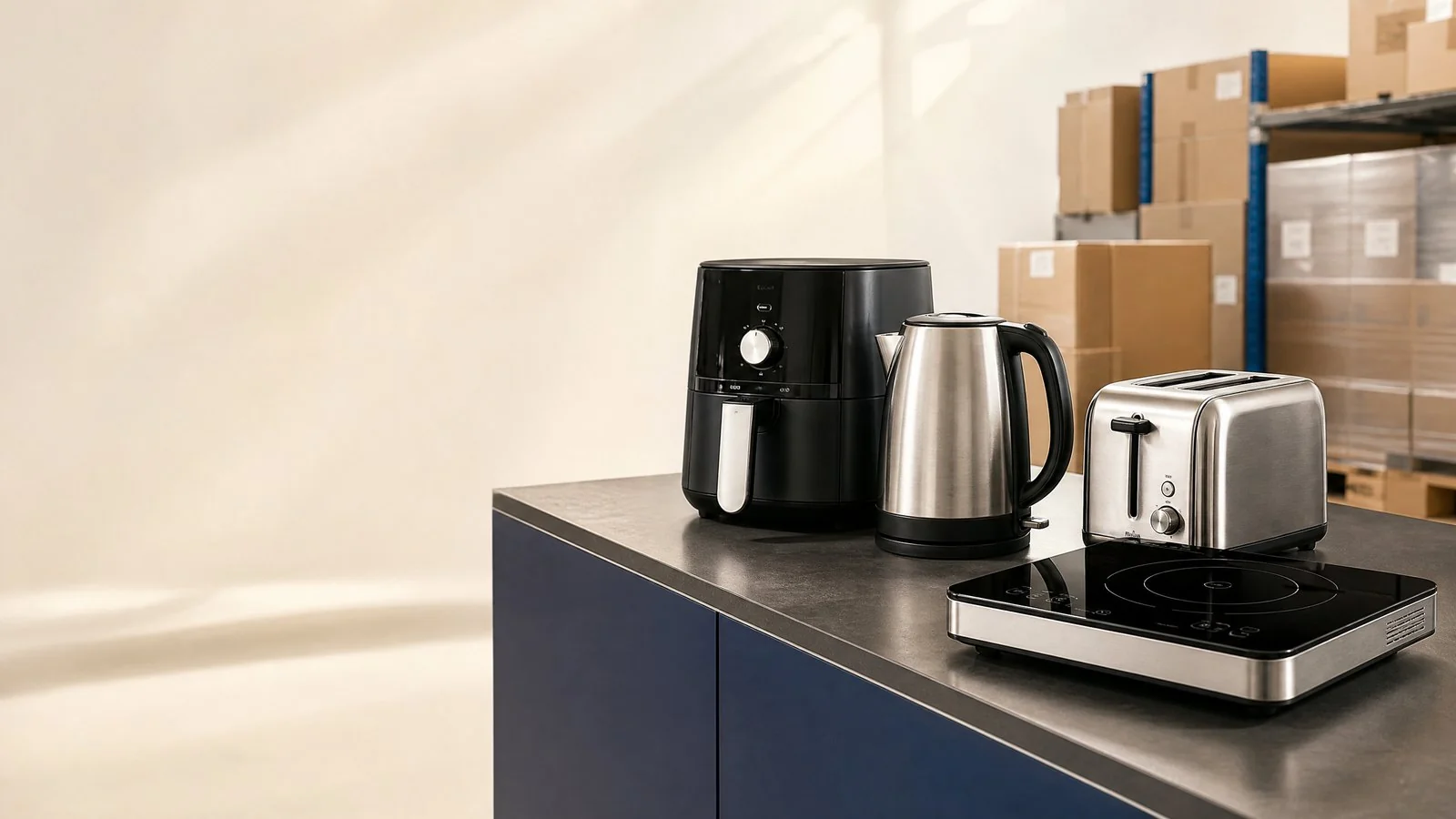
The Kitchen Appliance Wholesale Opportunity in 2026
The market for kitchen appliances wholesale has reached an inflection point in 2026, presenting distributors and retailers with one of the most attractive sourcing opportunities in consumer goods. According to Euromonitor International, the global small kitchen appliance market exceeded $100 billion in 2025, and post-pandemic consumer behavior has permanently elevated home cooking as a daily ritual rather than an occasional activity. For kitchen appliance distributors, this translates into sustained demand across electric kettles, blenders, rice cookers, slow juicers, and air fryers, with emerging markets in Southeast Asia, Africa, and Latin America showing double-digit annual growth rates.
Three structural trends are driving the premiumization of small kitchen appliances sourcing. First, rising disposable incomes in developing markets are pushing consumers from basic commodity appliances toward feature-rich, branded products with digital controls and smart functionality. Second, health-conscious consumers are investing in specialized appliances such as slow juicers and air fryers that support wellness-oriented lifestyles, creating new product categories that did not exist a decade ago. Third, the consolidation of retail channels, particularly e-commerce platforms, has made it easier than ever for distributors to reach end consumers directly, compressing traditional retail margins and rewarding buyers who source efficiently. This guide provides a comprehensive roadmap for evaluating manufacturers, comparing prices across categories, ensuring food safety compliance, and building a multi-product sourcing strategy.
1. Top-Selling Kitchen Appliance Categories for Wholesale
Electric kettles represent the highest-volume category in kitchen appliances wholesale, driven by universal demand across both developed and developing markets. Material types range from economy plastic-body kettles at the entry level to premium stainless steel and glass models with variable temperature control. The global electric kettle market benefits from replacement-cycle demand, as kettles have a typical lifespan of 2 to 4 years with daily use. For distributors, the 1.7-liter stainless steel kettle with STRIX or Otter controller represents the sweet spot of volume, margin, and reliability, appealing to both household and office markets. Electric kettle wholesale pricing typically ranges from $3 to $12 FOB depending on material grade and controller brand.
Blenders span two distinct market segments: personal blenders with 300 to 600-watt motors and 600ml to 1-liter cups, and full-size blenders with 800 to 1,500-watt motors and 1.5 to 2-liter jars. A blender manufacturer China operation typically serves both segments, though full-size blenders require more sophisticated motor winding and blade balancing. The professional blender segment, featuring 1,500-watt motors with 30,000 RPM blade speeds, has grown rapidly as consumers replicate commercial smoothie and juice bar experiences at home. Rice cookers divide into conventional models with heating elements in the base and induction heating (IH) models that use electromagnetic fields for more uniform cooking. IH rice cookers command premium pricing but deliver noticeably superior rice texture. Capacities range from 1-liter mini cookers for single users to 5-liter family models.
Slow juicers, also known as masticating juicers, have emerged as a high-growth category driven by the cold-press health trend. Unlike centrifugal juicers that spin at 10,000 to 20,000 RPM and generate heat that degrades nutrients, slow juicers operate at 60 to 80 RPM using a spiral auger to crush and press produce, preserving enzymes and yielding higher juice extraction. Juicer OEM orders for slow masticating models typically carry higher margins than centrifugal alternatives, with FOB prices ranging from $10 to $35 depending on motor quality and auger design. Air fryers, covered in detail in our dedicated air fryer sourcing guide, remain the fastest-growing kitchen appliance category, and many distributors bundle air fryers with blenders and kettles to create multi-product container shipments that optimize logistics costs.
2. How to Evaluate Kitchen Appliance Manufacturers
Factory certifications provide the first quantitative signal of a manufacturer’s reliability. ISO 9001:2015 certification demonstrates that a factory maintains a documented quality management system, covering everything from incoming material inspection to final product testing. While ISO 9001 is table stakes for any serious manufacturer, additional certifications such as BSCI (Business Social Compliance Initiative) and Sedex SMETA audits signal commitment to ethical labor practices, which is increasingly required by European retailers. Production capacity, measured in monthly output units, should be verified against your projected order volume: a factory producing 50,000 kettles per month can comfortably handle a 5,000-piece order, while a 5,000-unit-per-month factory may struggle with the same order during peak season.
Research and development capability distinguishes a true manufacturing partner from a mere assembler. A credible rice cooker supplier or blender manufacturer should employ dedicated R&D engineers who can modify existing designs, develop new product features, and produce functional prototypes within 2 to 4 weeks. Mold ownership is a critical evaluation point: factories that own their molds can offer OEM customization at lower cost and faster turnaround, while factories that rely on external mold makers add lead time and cost to every custom project. Export experience, measured in years of international trade and number of markets served, indicates a factory’s familiarity with destination-country certification requirements, packaging standards, and documentation procedures.
A practical factory audit checklist should cover six areas: production floor cleanliness and organization, equipment age and maintenance condition, workforce skill level and training programs, quality control station setup and staffing, raw material storage and traceability, and finished goods warehousing and shipping procedures. Request client references from distributors in markets similar to yours, and contact them to verify product quality consistency, on-time delivery performance, and after-sales responsiveness. For high-value or long-term sourcing relationships, commission a third-party factory audit through SGS, Intertek, or TUV. These audits cost $500 to $1,500 but can prevent far more expensive quality failures and supply disruptions down the line.
3. Material Quality and Food Safety Standards
Material quality directly determines product safety, durability, and regulatory compliance. Food-grade stainless steel is graded by composition: 304-grade (18/8 chromium-nickel) is the standard for food-contact surfaces in kettles, blender jars, and rice cooker inner pots because it resists corrosion, does not impart metallic taste, and withstands repeated thermal cycling. 201-grade steel, containing manganese instead of nickel, is significantly cheaper but prone to rust and pitting, especially in humid environments or with acidic foods. A reputable manufacturer should specify 304-grade steel in product specifications and provide material certificates from their steel supplier. For budget product lines, 430-grade ferritic steel is an acceptable middle ground for non-heating components.
Plastic selection for food-contact components follows a strict hierarchy. BPA-free Tritan, manufactured by Eastman, is the premium choice for blender jars and juicer containers because it is shatter-resistant, does not retain odors or stains, and is fully dishwasher-safe. Polycarbonate (PC), while durable, has been restricted in many markets due to BPA concerns. Polypropylene (PP) is the standard for rice cooker inner lids and steam vents, offering heat resistance to 120 degrees Celsius. For non-stick coatings on air fryer baskets and rice cooker pots, PFOA-free PTFE coatings and ceramic coatings are the two primary options, both compliant with FDA and LFGB standards. Silicone seals used in slow juicers and rice cookers must be food-grade (platinum-cured) to prevent off-gassing at operating temperatures.
Glass components, such as kettle bodies and blender jars, should be made from borosilicate glass, which withstands thermal shock from rapid temperature changes without cracking. Compliance with international food-contact regulations is mandatory across all markets: FDA 21 CFR in the United States, EU Regulation 1935/2004 in Europe, LFGB in Germany, and GB 4806 series in China. Each regulation specifies migration limits for heavy metals, plasticizers, and other substances that could transfer from the material into food. A reliable manufacturer maintains a compliance dossier for every food-contact material, including third-party test reports from accredited laboratories. Request these documents during supplier evaluation and verify that test reports are current, as material formulations can change between production batches.
4. Price Comparison Across Kitchen Appliance Categories
FOB pricing for kitchen appliances varies widely by category, driven by component complexity, motor quality, material grade, and smart feature integration. The following ranges reflect 2026 market rates from established Chinese manufacturers at 1,000-piece order quantities with standard specifications. Electric kettles range from $3 to $12 FOB, with plastic-body economy models at $3 to $5, standard stainless steel models at $5 to $8, and premium variable-temperature glass models at $8 to $12. Blenders span $5 to $25, from personal blenders at $5 to $8 to full-size 1,500-watt professional blenders at $15 to $25. Rice cookers range from $6 to $30, with conventional models at $6 to $12 and IH smart models at $18 to $30. Slow juicers command $10 to $35 FOB, reflecting the precision engineering of the masticating auger.
Several factors drive price differences within each category. Motor quality is the single largest cost variable for blenders and juicers: a copper-wound motor with sealed bearings costs 30 to 50 percent more than an aluminum-wound alternative but delivers 2 to 3 times the operational lifespan. Material grade affects both cost and perceived quality: upgrading from 201 to 304 stainless steel adds $0.80 to $1.50 per unit but significantly improves corrosion resistance and customer satisfaction. Smart features, including digital touchscreens, WiFi connectivity, and companion apps, add $3 to $8 per unit and require additional certification for wireless modules. Brand positioning also influences factory pricing: manufacturers apply tiered pricing based on whether you position the product as budget, mid-range, or premium, with premium positioning sometimes requiring exclusive distribution agreements.
For kitchen appliance distributors planning multi-product containers, the blended cost per unit is more meaningful than individual category prices. A typical mixed container might include 2,000 electric kettles at $6 each, 1,000 blenders at $12 each, 800 rice cookers at $10 each, and 500 slow juicers at $20 each, totaling 4,300 units with a blended FOB cost of $9.07 per unit. This approach allows distributors to offer a full product range to retail customers while optimizing container utilization and reducing per-unit shipping costs. When requesting quotes, ask each supplier for their complete product catalog and tiered pricing, because a factory that produces both kettles and blenders can often offer better consolidated pricing than two separate specialists.
5. Building a Multi-Product Sourcing Strategy
The fundamental strategic decision in multi-product sourcing is whether to consolidate orders with a single full-line factory or distribute across multiple category specialists. A single-factory approach simplifies communication, negotiation, quality management, and logistics, because you deal with one supplier for quotations, samples, production scheduling, and shipping. Factories that produce multiple categories, such as HousePlus which manufactures air fryers, kettles, blenders, juicers, and rice cookers, can consolidate orders into a single container, reducing per-unit freight costs by 15 to 25 percent compared to LCL (less-than-container-load) shipments from multiple suppliers. The trade-off is that a single-factory approach may sacrifice best-in-class quality in some categories, since no factory excels equally at every product type.
Container optimization is a critical factor in multi-product sourcing profitability. A 40-foot high-cube container holds approximately 68 cubic meters of cargo. Electric kettles, packed 12 per carton, typically yield 4,000 to 5,000 units per container. Blenders, packed 4 per carton, yield 1,800 to 2,500 units. Rice cookers yield 2,000 to 3,000 units, and slow juicers 1,500 to 2,000 units. A mixed container combining 2,000 kettles, 1,000 blenders, 800 rice cookers, and 500 juicers fills approximately 60 cubic meters, leaving room for additional product or reducing the container to a standard 40-foot. Negotiation leverage increases with multi-product orders: a combined order of $50,000 across five categories gives you significantly more pricing power than five separate $10,000 orders.
Quality consistency across categories requires a systematic approach. When sourcing from a single factory, establish uniform quality control standards, AQL sampling protocols, and packaging specifications across all products. For multi-factory sourcing, create a standardized supplier quality requirement document (SQRD) that every factory must sign and adhere to, covering material specifications, testing protocols, certification requirements, and packaging standards. Warranty and after-sales support terms should be negotiated upfront: define the defect rate threshold (typically 1 to 2 percent) above which the factory covers replacement costs, the RMA process for defective units, and the response time for quality complaints. A reliable manufacturer will stand behind their products with a 1 to 2 percent spare parts allowance and a clear claims process.
Conclusion: Your Kitchen Appliance Wholesale Roadmap
Building a profitable kitchen appliance wholesale business in 2026 requires more than finding cheap products. The most successful distributors take a strategic approach: they identify the right product mix for their target markets, evaluate manufacturers against rigorous quality and certification benchmarks, understand the material and component factors that drive price differences, and optimize their sourcing strategy to maximize container utilization and negotiation leverage. Whether you are launching a new distribution business or scaling an existing operation, the framework in this guide will help you make informed, data-driven sourcing decisions that protect your margins and build customer loyalty.
For a HousePlus kitchen-appliance inquiry, share the target product categories, destination market, required configuration and branding requirements. Our team can review available models, samples, product-specific documentation, OEM/ODM scope and quotation terms for your proposed order. Contact Jack at jack@houseplus-ch.com or +86-155-7811-9543 (WhatsApp: +8615578119543) to begin the review.
Request a Wholesale Quote from HousePlus
Contact our team to discuss product requirements, OEM/ODM capabilities, applicable documentation and quotation terms.
Contact HousePlus