
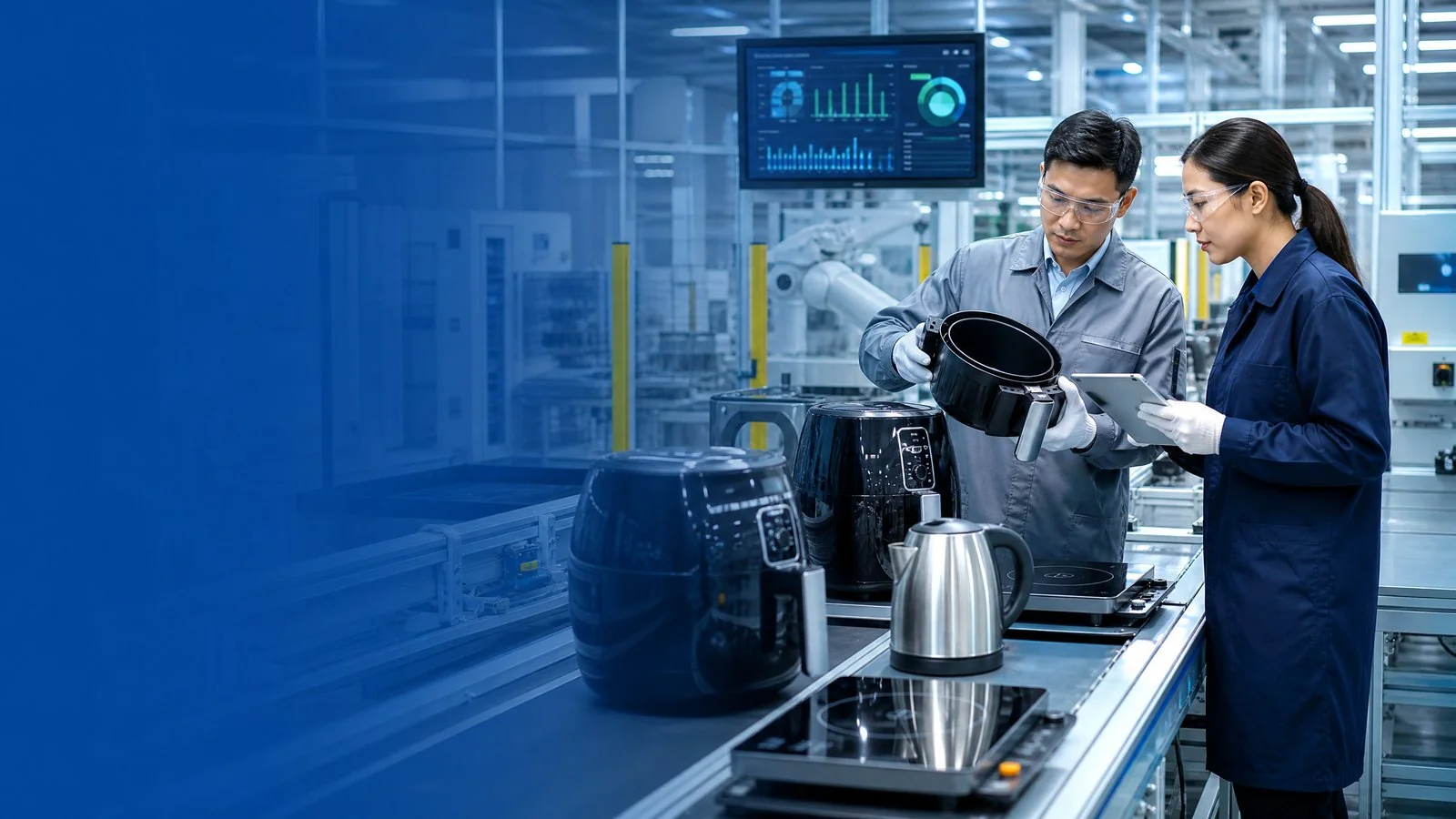
Why China Dominates Home Appliance Manufacturing in 2026
Finding the right home appliance OEM manufacturer in China has become the defining procurement decision for B2B buyers, brand owners, and distributors in 2026. The global small appliance market surpassed $250 billion in 2026 according to Statista, and China produces more than 70 percent of the world’s small home appliances, making it the indispensable sourcing destination for brands and retailers worldwide. From air fryers and electric kettles to blenders and rice cookers, Chinese factories combine mature supply chains, skilled labor, and aggressive pricing in a way no other country can match at scale.
For importers seeking reliable home appliance sourcing from China, the challenge is no longer finding a factory but finding the right factory. Thousands of manufacturers compete across hubs like Zhongshan, Shunde, Ningbo, and Cixi, and the gap between a world-class appliance factory Zhongshan operation and a marginal workshop can be enormous. This guide provides a structured framework for evaluating OEM ODM appliance partners, covering manufacturing landscape, OEM versus ODM models, quality standards, certifications, pricing structures, and quality control processes. Whether you are launching a private-label kitchen appliance brand or scaling an existing distribution network, these criteria will help you de-risk your supply chain.
1. Understanding the Home Appliance Manufacturing Landscape in China
China’s home appliance manufacturing is concentrated in several specialized industrial hubs, each with distinct strengths. The Pearl River Delta region, anchored by Zhongshan and Shunde in Guangdong province, is the undisputed center for small kitchen appliance manufacturing. Zhongshan alone hosts thousands of appliance factories producing air fryers, electric kettles, blenders, rice cookers, and slow juicers, supported by a dense network of component suppliers, mold makers, and packaging vendors. The Yangtze River Delta, centered on Ningbo and Cixi in Zhejiang province, specializes in electric kettles, heaters, and personal care appliances, while Shunde dominates larger white goods such as refrigerators and washing machines.
Within these hubs, factories fall into two broad categories: vertically integrated manufacturers and assembly-only operations. Vertically integrated factories like HousePlus control injection molding, PCB assembly, motor winding, final assembly, and quality testing under one roof, which delivers tighter consistency and faster iteration on custom specifications. Assembly-only factories purchase components from third-party suppliers and focus on final assembly, offering lower overhead but less control over component quality and longer development cycles for new products. For B2B buyers, vertically integrated manufacturers are almost always the safer choice for OEM ODM appliances, because they own the critical production processes that determine product reliability.
Product categories within small appliance manufacturing span kitchen appliances (air fryers, electric kettles, blenders, slow juicers, rice cookers), personal care devices (hair dryers, electric shavers), and floor care products (cordless vacuums, steam mops). According to Euromonitor International, small kitchen appliances represent the largest and fastest-growing segment, driven by health-conscious cooking trends and rising disposable incomes in emerging markets. Understanding which categories a factory specializes in is essential, because a factory excelling at air fryers may lack the motor expertise required for high-performance blenders or slow juicers.
2. Evaluating OEM vs ODM for Home Appliance Manufacturing
The choice between OEM and ODM manufacturing fundamentally shapes your cost, timeline, and intellectual property position. Under the OEM model, the manufacturer uses its existing product mold and design, and you apply custom branding, packaging, and minor cosmetic modifications such as color changes or logo placement. OEM is the fastest and most cost-effective path to market, with minimum order quantities typically starting at 500 to 1,000 pieces and lead times of 25 to 35 days. You benefit from a proven, tested design that has already passed certification, reducing both development cost and regulatory risk.
Under the ODM model, you commission a fully custom product design with a purpose-built mold tailored to your specifications. This approach allows unique features, proprietary aesthetics, and differentiated performance characteristics that set your brand apart. However, ODM requires significantly higher investment: custom mold costs range from $15,000 to $80,000 depending on product complexity, MOQ typically rises to 3,000 pieces or more, and the development cycle spans 60 to 120 days from concept to production-ready samples. ODM is the right choice when your brand strategy demands product exclusivity that OEM cannot deliver.
Intellectual property considerations should drive the OEM versus ODM decision. With OEM, the factory owns the mold and design, meaning competitors can purchase the same base product with different branding. With ODM, negotiate mold ownership terms explicitly: ideally, you own the mold and the factory cannot sell your design to others. Cost-wise, OEM air fryers at 1,000 pieces might cost $12 per unit, while an ODM equivalent with a custom mold amortized over the first 5,000 units might cost $14 per unit plus a $30,000 mold fee, breaking even only at higher volumes. Time to market is the final factor: OEM gets products on shelves in 6 to 8 weeks, while ODM requires 4 to 6 months from concept to container.
3. Key Quality Standards and Testing Requirements
Material safety is the foundation of home appliance quality, particularly for products that contact food. Food-grade, BPA-free plastics such as Tritan and polypropylene are mandatory for air fryer baskets, blender jars, and rice cooker inner pots. Stainless steel components should be 304-grade (18/8) rather than 201-grade, which is cheaper but susceptible to corrosion and rust. Reputable manufacturers test all food-contact materials against FDA (United States) and LFGB (Germany) standards, and they should provide material compliance certificates on request. Non-food-contact components, such as housings and handles, must meet flame-retardant requirements under UL 94 V-0 or equivalent standards.
Electrical safety testing encompasses both the low-voltage directive (LVD) and electromagnetic compatibility (EMC) requirements. Every appliance must pass dielectric strength testing at 1,500 to 3,000 volts for one minute without breakdown, leakage current testing below 0.5 mA, and grounding continuity testing at 25 amps. EMC testing verifies that the appliance neither emits excessive electromagnetic interference nor is susceptible to external interference, which is critical for products with digital controls or WiFi modules. Manufacturers should maintain test records for each production batch and provide third-party test reports from accredited laboratories such as TUV, Intertek, or SGS.
Motor quality and lifespan testing separates durable appliances from disposable ones. A quality fan motor in an air fryer or blender should survive 500 to 1,000 hours of continuous operation under load, verified through accelerated life testing. Thermostat accuracy is equally critical: a well-calibrated air fryer thermostat should maintain temperature within plus or minus 5 degrees Celsius of the set point, preventing undercooked food or burned baskets. For appliances used near water, such as electric kettles and slow juicers, waterproof rating (IPX4 or higher) and splash-resistant motor housings are essential. The Association of Home Appliance Manufacturers (AHAM) recommends that buyers request detailed test protocols and historical failure rate data before committing to volume orders.
4. Essential Certifications for Home Appliance Export
Certifications are non-negotiable for cross-border home appliance trade, and the specific requirements depend on your target market. For the European Union, every appliance must carry CE marking under the Low Voltage Directive 2014/35/EU and the EMC Directive 2014/30/EU. CE marking requires a technical construction file, risk assessment, and test reports from a notified body. Additionally, RoHS compliance restricts hazardous substances such as lead, mercury, and cadmium, while REACH registration ensures chemical safety for all materials. The GS mark, issued by German certification bodies, is voluntary but highly valued by EU retailers as proof of enhanced safety testing.
For the United States, ETL or UL listing is the standard safety certification. ETL (Intertek) and UL (Underwriters Laboratories) both test to UL standards such as UL 1026 for household electric ranges and cooking appliances. The FDA regulates food-contact materials under 21 CFR, requiring that all components touching food meet specific migration limits. For Japan, PSE certification under the Electrical Appliance and Material Safety Law is mandatory, while Korea requires KC marking. Food contact materials compliance is universal: in the EU, Regulation 1935/2004 governs food-contact materials; in Germany, LFGB testing is the gold standard; and in China, GB 4806 series standards apply. Always request actual certificate PDFs and verify them against the issuing body’s database, because counterfeit certificates are common among less reputable suppliers.
5. Pricing Structures and MOQ for Home Appliance Manufacturing
Understanding the component cost breakdown of a home appliance helps you evaluate whether a factory’s quotation is competitive. For a typical small kitchen appliance such as an air fryer, the cost structure breaks down roughly as follows: motor and fan assembly accounts for 20 percent, plastic housing and components 15 percent, PCB and electronic controls 12 percent, heating element 10 percent, assembly labor 18 percent, packaging 8 percent, and quality control 7 percent. The remaining 10 percent covers overhead, tooling amortization, and profit margin. When a factory quotes a price significantly below this structure, it is likely substituting inferior components, such as 201-grade steel instead of 304 or a cheaper motor with a shorter lifespan.
Pricing tiers scale steeply with order volume. The following FOB price ranges reflect 2026 market rates from established Chinese manufacturers. At 500 pieces, a 6-liter digital air fryer costs $14 to $18 per unit; at 1,000 pieces, $12 to $15; at 3,000 pieces, $10 to $13; and at 5,000 pieces, $8 to $11. Electric kettles follow a similar curve: $6 to $8 at 500 pieces, dropping to $4 to $5 at 5,000 pieces. Blenders range from $10 to $18 at 500 pieces and $6 to $12 at 5,000 pieces. Rice cookers span $12 to $18 at 500 pieces and $8 to $14 at 5,000 pieces. These ranges assume standard specifications; ODM customization with custom molds adds 10 to 20 percent to the base price.
When comparing quotes across suppliers, always confirm the Incoterm (FOB, EXW, or CIF), currency, and whether the price includes certification costs, packaging, and labeling. Some factories quote low EXW prices that exclude domestic freight, export documentation, and palletizing, which can add 5 to 8 percent to the real cost. For first-time buyers, FOB pricing is the most transparent basis for comparison because it includes all costs up to the port of loading. Request tiered quotations at 500, 1,000, 3,000, and 5,000 pieces from at least three suppliers to establish a realistic market price and identify outliers.
6. Quality Control Process in Appliance Manufacturing
A robust quality control process in appliance manufacturing operates across three stages: incoming, in-process, and final. Incoming Quality Control (IQC) inspects all raw materials and components before they enter production, verifying motor specifications, PCB functionality, plastic resin grade, and metal thickness against approved samples. A serious factory rejects 2 to 5 percent of incoming materials on average, and if a supplier claims zero rejections, that is a red flag indicating either lax inspection or falsified records. IQC also includes material certificate verification for food-grade plastics and stainless steel grades.
In-Process Quality Control (IPQC) monitors the production line at defined checkpoints. For air fryer assembly, IPQC checks heating element resistance, thermostat calibration, motor mounting torque, and PCB solder joint quality at each workstation. Statistical process control charts track critical parameters, and any deviation triggers immediate corrective action before the defect propagates downstream. Final Quality Control (FQC) performs 100 percent functional testing on every finished unit, including power-on test, heating performance, timer accuracy, and safety feature verification. Additionally, 100 percent aging tests run each appliance for 30 to 60 minutes under full load to catch early-life failures that would otherwise reach the customer.
Beyond functional testing, physical durability tests validate product ruggedness. Drop tests from 80 centimeters onto a concrete surface simulate shipping and handling, while salt spray tests verify corrosion resistance of metal components over 24 to 72 hours. Sampling inspection follows AQL (Acceptable Quality Limit) standards, typically AQL 2.5 for major defects and AQL 4.0 for minor defects, as defined by ISO 2859-1. Under AQL 2.5, a batch of 1,000 units with more than 10 major defects fails inspection and is held for rework. Buyers should request the factory’s AQL inspection report for each shipment and, for high-value orders, commission a third-party pre-shipment inspection through SGS, Intertek, or TUV to independently verify quality before payment.
Conclusion: Building a Reliable Home Appliance Supply Chain
Building a reliable home appliance supply chain from China in 2026 demands far more than finding the lowest factory-gate price. The most successful B2B buyers take a holistic approach: they evaluate the manufacturing landscape to identify the right hub and factory type, choose between OEM and ODM based on their brand strategy and timeline, enforce rigorous quality and certification standards, understand the true cost structure behind every quotation, and verify quality control processes through factory audits and third-party inspections. A 10 percent saving on unit cost is meaningless if it results in a 5 percent field failure rate that triggers returns, warranty claims, and reputational damage.
For a HousePlus home-appliance inquiry, share your product category, target market, configuration and branding requirements. Our team can discuss available models, samples, product-specific documentation, OEM/ODM scope and quotation terms after reviewing your request. Contact Jack at jack@houseplus-ch.com or +86-155-7811-9543 (WhatsApp: +8615578119543) to begin the review.
Request a Wholesale Quote from HousePlus
Contact our team to discuss product requirements, OEM/ODM capabilities, applicable documentation and quotation terms.
Contact HousePlus