
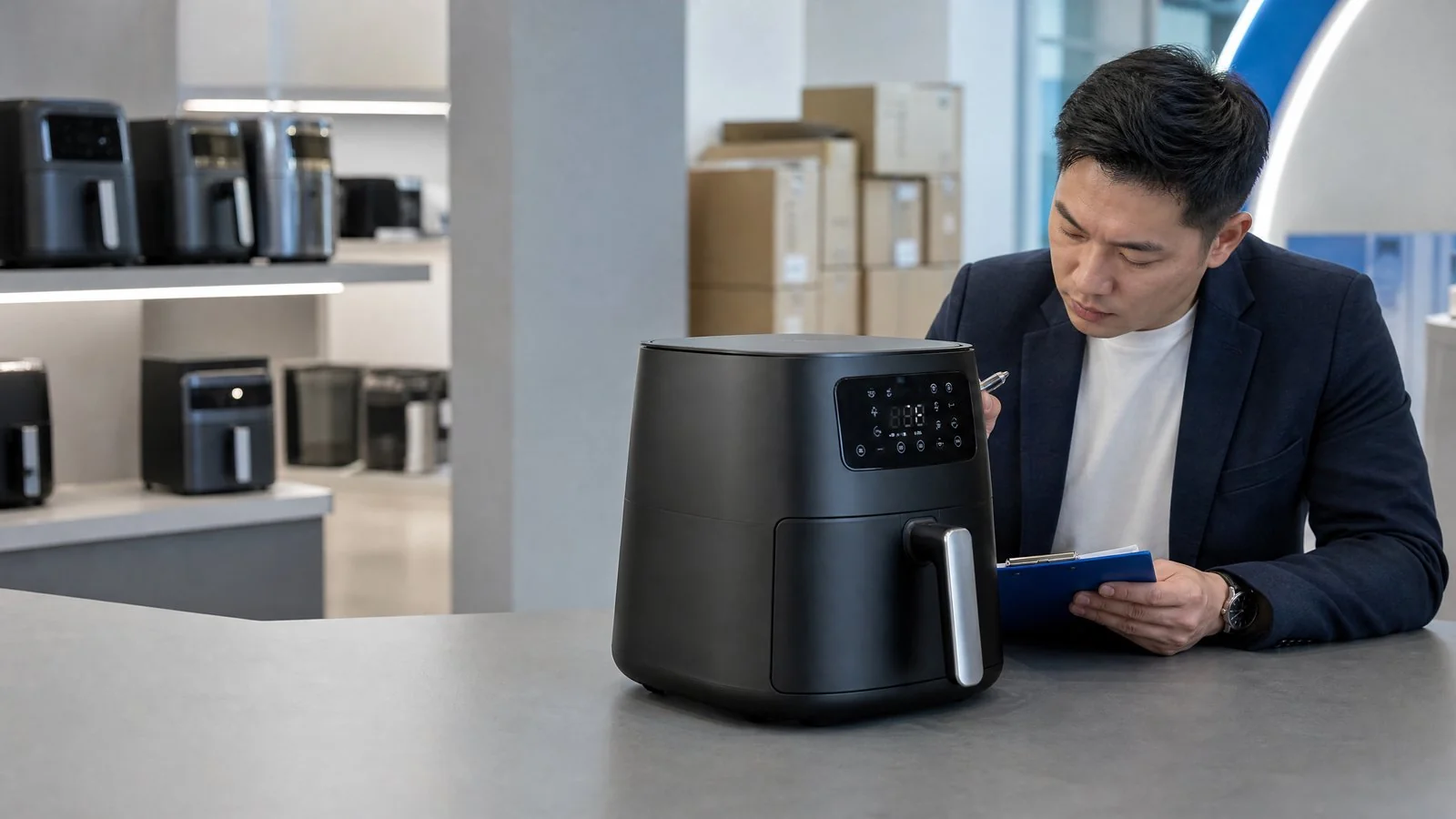
The Air Fryer Market Boom: Why 2026 Is the Year to Source
Partnering with the right air fryer manufacturer in China has never been more strategic than in 2026. According to Grand View Research, the global air fryer market reached $1.2 billion in 2025 and is projected to grow at a compound annual rate of 7.3 percent through 2030, driven by the global shift toward health-conscious cooking and the convenience of countertop convection appliances. For B2B buyers, distributors, and private-label brand owners, this sustained demand creates a compelling opportunity to source air fryers from Chinese factories that combine mature manufacturing expertise with competitive pricing and flexible OEM customization.
The consumer trends fueling air fryer sourcing are structural rather than faddish. Post-pandemic cooking habits have permanently shifted toward home meal preparation, and air fryers address the dual consumer demand for healthier food with significantly less oil and faster cooking times than conventional ovens. Euromonitor International reports that household penetration of air fryers in North America exceeded 40 percent in 2025, while European and Asia-Pacific markets are still in rapid growth phases with penetration below 20 percent, signaling substantial runway for distributors entering these regions. This guide walks through every aspect of air fryer wholesale sourcing, from technology and quality evaluation to certifications, pricing, and OEM customization.
1. Understanding Air Fryer Technology and Capacity Options
Air fryers operate on rapid air technology, a convection mechanism that circulates superheated air at high velocity around food to produce a crispy exterior with minimal oil. A heating element, typically 800 to 2,000 watts, raises air temperature to between 80 and 200 degrees Celsius, while a powerful fan distributes the hot air evenly throughout the cooking chamber. The rapid air circulation creates a Maillard reaction on the food surface, replicating the texture of deep frying with up to 90 percent less oil. Understanding this mechanism is essential for evaluating manufacturer quality, because the performance of the heating element and fan motor directly determines cooking consistency and product lifespan.
Capacity options span a wide range to serve different household sizes and commercial applications. Compact 2-liter models, drawing 800 to 1,000 watts, suit single-person households and small kitchens. The 3.5-liter to 4-liter range, at 1,200 to 1,500 watts, is the most popular for couples and small families. The 5-liter to 6-liter tier, at 1,500 to 1,700 watts, serves families of four to six and has become the bestselling export category. Large 8-liter models, at 1,800 to 2,000 watts, target bulk cooking and commercial use. Temperature range is typically 80 to 200 degrees Celsius, and modern units offer 6 to 12 preset cooking modes for foods such as fries, chicken, fish, steak, and baked goods.
Smart features are increasingly differentiating premium air fryer models. WiFi connectivity and companion smartphone apps allow remote control, recipe browsing, and cooking notifications, appealing to tech-savvy consumers. Some models integrate voice control through Amazon Alexa or Google Assistant. Digital touchscreens with pre-programmed timers and shake reminders have largely replaced mechanical dials in mid-range and above models. For B2B buyers, the decision between analog and smart models affects both unit cost and target market positioning: smart models command 30 to 50 percent higher retail prices but require app development investment and ongoing firmware support. When evaluating an air fryer manufacturer, confirm whether smart features are developed in-house or outsourced, as this impacts long-term product support and customization flexibility.
2. Key Quality Factors When Evaluating Air Fryer Manufacturers
Heating element quality is the single most important determinant of air fryer performance and durability. A premium heating element should reach full operating temperature within 60 to 90 seconds and maintain consistent output across thousands of cooking cycles. Look for manufacturers using stainless steel or ceramic-coated heating elements rather than cheaper nichrome alternatives, which degrade faster and produce uneven heat. The fan motor is equally critical: a quality motor should deliver a lifespan of 3,000 operating hours or more, verified through continuous load testing. Inferior motors fail prematurely, producing reduced airflow, uneven cooking, and eventually complete product failure.
Thermostat accuracy separates reliable air fryers from inconsistent ones. A well-calibrated thermostat should maintain the set temperature within plus or minus 5 degrees Celsius throughout the cooking cycle. Thermostats with wider variance produce undercooked or burned food, leading to customer complaints and returns. During factory evaluation, request thermostat calibration test data and verify that the manufacturer performs 100 percent thermostat testing on every unit during final quality control. Basket coating quality is another essential factor: all coatings must be PFOA-free, and premium models use ceramic or stainless steel baskets that resist scratching and peeling over the product lifespan. Non-stick coatings should meet FDA and LFGB food-contact standards.
Safety features are non-negotiable for any air fryer destined for international markets. Essential safety mechanisms include auto shut-off when the basket is removed during operation, cool-touch handles that prevent burns, overheat protection that cuts power if internal temperature exceeds safe limits, and non-slip feet for countertop stability. The Association of Home Appliance Manufacturers (AHAM) recommends that all air fryers carry independent safety certifications and that manufacturers maintain documented test records for each safety feature. When evaluating suppliers, request the complete safety test protocol and verify that every safety function is tested on 100 percent of production units, not just a sample batch.
3. Air Fryer Certifications and Compliance Requirements
Certification requirements for air fryers vary by destination market but share common safety and material compliance principles. For the European Union, CE marking is mandatory under both the Low Voltage Directive and the EMC Directive, verifying electrical safety and electromagnetic compatibility. RoHS compliance restricts hazardous substances in electronic components, and REACH registration ensures chemical safety for all materials used in the product. For food-contact components, EU Regulation 1935/2004 and German LFGB testing are required, confirming that basket coatings and internal surfaces do not migrate harmful substances into food at cooking temperatures.
For the United States, ETL or UL certification is the standard safety requirement, testing to UL 1026 standards for household electric cooking appliances. The FDA regulates food-contact materials under 21 CFR, requiring that all surfaces touching food meet specific migration limits for heavy metals and organic compounds. For Japan, PSE certification under the Electrical Appliance and Material Safety Law is mandatory, while Korea requires KC marking. Food-grade material compliance is universal across all markets: baskets must be BPA-free and PFOA-free, and manufacturers should provide material test reports from accredited laboratories such as SGS, Intertek, or TUV. Always request actual certificate PDFs, not supplier claims, and cross-check certificate numbers against the issuing body’s online database to detect counterfeits.
4. Pricing Analysis: Air Fryer Manufacturing Costs Explained
Understanding the component cost breakdown of an air fryer helps B2B buyers evaluate whether a factory quotation reflects genuine value or hidden quality compromises. For a standard 6-liter digital air fryer, the cost structure breaks down approximately as follows: heating element accounts for 15 percent of total cost, fan motor 18 percent, plastic housing and components 20 percent, PCB and electronic controls 10 percent, basket and non-stick coating 12 percent, assembly labor 15 percent, packaging 5 percent, and quality control 5 percent. When a supplier quotes a price significantly below this structure, scrutinize which components have been downgraded, because the most common substitutions are cheaper motors with shorter lifespans and lower-grade plastics that may not meet food-contact standards.
FOB prices vary substantially by capacity and order volume. The following ranges reflect 2026 market rates from established Chinese air fryer manufacturers. For 2-liter compact models, FOB pricing ranges from $5 to $8 per unit. For 4-liter models, $7 to $12. For 6-liter digital models, the most popular export size, $10 to $18. For 8-liter large-capacity models, $14 to $25. These prices assume standard specifications with CE and RoHS certifications. Adding ETL or UL certification typically increases the unit price by $0.50 to $1.50, and smart features with WiFi and app control add $3 to $6 per unit. ODM customization with a custom mold adds a one-time tooling fee of $20,000 to $50,000.
MOQ tiers directly affect per-unit pricing. At 500 pieces, a 6-liter digital air fryer might cost $15 per unit FOB. At 1,000 pieces, the price drops to $13. At 3,000 pieces, $11. And at 5,000 pieces or more, $9 to $10. The price break between 500 and 1,000 pieces is usually the steepest in percentage terms, typically 10 to 15 percent, because it crosses the threshold from small-batch to scheduled mass production. For buyers who cannot reach 1,000-piece volume independently, consolidating orders across multiple SKUs or partnering with other distributors can unlock better tier pricing. Always request a complete tiered quotation at 500, 1,000, 3,000, and 5,000 pieces before committing to a supplier.
5. OEM Customization Options for Air Fryer Brands
OEM customization allows brand owners to differentiate their air fryers without the cost and timeline of full ODM product development. The most common customization is color and finish: factories can produce air fryers in virtually any Pantone-matched color, with matte, gloss, or metallic finishes, subject to a 500-piece minimum per color. Logo printing options include silk screening, UV printing, and embossed molding, each offering different durability and visual effects. Custom packaging design is another essential OEM service, allowing brands to create retail-ready boxes with their own graphics, multilingual instructions, and accessory inserts. Most factories include basic OEM customization (logo and packaging) at no additional mold cost within the standard MOQ.
For brands seeking deeper differentiation, private mold creation offers exclusive product designs that competitors cannot replicate. A private air fryer mold costs $20,000 to $50,000 depending on complexity and requires 30 to 45 days for fabrication and sample approval. Custom preset programming allows brands to define unique cooking modes tailored to regional cuisines, such as specific programs for samosas in South Asian markets or tempura in Japanese markets. Smart model development, including custom companion apps with branded recipe content and remote control functionality, typically requires an additional investment of $5,000 to $15,000 and 60 to 90 days of development time. When negotiating OEM terms, clarify which customizations are included in the base price and which carry additional fees, and ensure that mold ownership terms are documented in the manufacturing agreement.
Conclusion: Sourcing Quality Air Fryers for Your Market
Sourcing quality air fryers from China in 2026 offers exceptional opportunity for B2B buyers who approach the process with diligence and market knowledge. The global air fryer market’s projected 7.3 percent CAGR through 2030, combined with low household penetration in growth markets, creates a compelling business case for distributors and private-label brands. Success depends on evaluating manufacturers against clear quality benchmarks, verifying certifications for your target markets, understanding the true cost structure behind every quotation, and leveraging OEM customization to build a differentiated product offering.
For a HousePlus air fryer inquiry, share your target capacity, product configuration, destination market and branding requirements. Our team can discuss available models, samples, product-specific documentation, OEM/ODM scope and the quotation terms applicable to your order. Contact Jack at jack@houseplus-ch.com or +86-155-7811-9543 (WhatsApp: +8615578119543) to begin the review.
Request a Wholesale Quote from HousePlus
Contact our team to discuss product requirements, OEM/ODM capabilities, applicable documentation and quotation terms.
Contact HousePlus