
Why the TWS Earphones Market Is Booming in 2026
The global TWS earphones OEM market has become one of the fastest-growing segments in consumer electronics, and brands sourcing Bluetooth earbuds from China are uniquely positioned to capture this momentum. According to Counterpoint Research, the global true wireless stereo market exceeded 300 million units shipped in 2025, generating over 45 billion US dollars in revenue. This trajectory continues into 2026, with IDC projecting a compound annual growth rate of 14 percent through 2028. Three structural forces drive this expansion: the universal removal of the 3.5mm headphone jack from flagship smartphones, the democratization of active noise cancellation at sub-30-dollar retail prices, and the maturation of Bluetooth 5.3 chipset supply from Qualcomm, Airoha, and Bestechnic.
For B2B buyers and brand owners, this boom creates extraordinary sourcing opportunity alongside intensifying competition. A capable TWS earphone factory in Shenzhen or Zhongshan can now deliver fully certified Bluetooth 5.3 earphones with ANC noise cancelling earbuds functionality at a bill of materials cost as low as 6 to 9 US dollars, enabling retail price points between 19 and 49 dollars. The wireless earphones wholesale channel has matured to the point where emerging brands can launch a competitive product line with a 500-unit minimum order. Understanding the complete earphone OEM ODM value chain, from chipset selection through certification and packaging, separates profitable product launches from costly failures.
1. Understanding TWS Earphone Technology and Components
At the heart of every TWS earphone is a system-on-chip Bluetooth SoC that manages wireless connectivity, audio decoding, and power management in a single package. Bluetooth 5.3, the current mainstream standard, delivers meaningful improvements over Bluetooth 5.2 and 5.0: 50 percent faster connection establishment, enhanced interference suppression through the Periodic Advertising Enhancement feature, and a 30 percent reduction in power consumption during idle states. Audio codec support is equally critical. The SBC codec is mandatory for all Bluetooth audio devices, but premium TWS earphones OEM products increasingly support AAC for Apple ecosystem compatibility, aptX and aptX HD for low-latency Qualcomm-based streaming, and LDAC for Sony-compatible high-resolution audio at up to 990 kbps.
Driver unit selection determines the fundamental sound signature of a TWS earphone. Most wireless earphones wholesale models use dynamic drivers ranging from 6mm to 13mm in diameter. Smaller 6mm drivers excel at vocal clarity and treble detail, making them ideal for podcast and call-focused earbuds. Larger 10mm to 13mm drivers deliver deeper bass response and wider soundstage, preferred by music enthusiasts. Premium ANC noise cancelling earbuds sometimes employ dual-driver hybrid configurations, pairing a balanced armature for highs with a dynamic driver for lows. According to acoustic engineering benchmarks published by the Bluetooth SIG, a well-tuned 13mm dynamic driver can achieve a frequency response of 20Hz to 20kHz with total harmonic distortion below 1 percent.
Active Noise Cancellation and Environmental Noise Cancellation represent two distinct but complementary technologies. ANC uses outward-facing microphones to capture ambient noise, then generates an inverse sound wave through the driver to cancel it, achieving 25 to 35dB of noise reduction in the 100Hz to 1kHz band where engine rumble and air conditioner hum dominate. ENC, by contrast, focuses on call quality by using beamforming microphones and digital signal processing to isolate the human voice from wind and background noise during phone calls. A well-engineered TWS earphone factory will implement both, with ANC protecting the listener and ENC ensuring the caller on the other end hears speech clearly even in a 70-decibel coffee shop environment.
2. Key Technical Specifications to Evaluate When Sourcing
When evaluating a Bluetooth earbuds manufacturer China supplier, the technical specification sheet is your primary due diligence document. Start with the Bluetooth version: Bluetooth 5.3 is the 2026 standard, offering the best balance of power efficiency, connection stability, and multipoint pairing capability. Avoid suppliers still offering Bluetooth 5.0 or 5.1 as the primary chipset, as these represent end-of-life inventory with inferior interference handling. The driver size should match your target market: 6mm to 8mm for budget and call-focused models, 10mm to 13mm for mainstream music earbuds. Frequency response should cover the full audible spectrum of 20Hz to 20kHz, and you should request the actual frequency response curve graph, not just the range specification.
Battery life benchmarks separate competitive products from also-rans. In 2026, the industry standard for earbuds alone is 4 to 8 hours of continuous playback at 50 percent volume, with the charging case providing an additional 20 to 40 hours of total playtime. Premium models with Bluetooth 5.3 and efficient codec usage can achieve 8 hours on a single charge. Charging time matters too: a 10-minute quick charge should deliver at least 60 minutes of playback. Water resistance is rated using the IPX system. IPX4 protects against splashing water and sweat, suitable for gym use. IPX5 adds protection against water jets. IPX7 withstands immersion in 1 meter of water for 30 minutes, the highest rating commonly found in TWS earphones.
Latency is a frequently overlooked specification that directly affects user satisfaction, particularly for gaming and video streaming. Standard TWS earphones exhibit 150 to 200 milliseconds of audio latency, which is acceptable for music and podcasts but causes noticeable lip-sync issues in video and renders competitive gaming impossible. Gaming-optimized models use specialized low-latency modes or proprietary 2.4GHz protocols to achieve 45 to 65 milliseconds. When sourcing gaming TWS earphones, specify a maximum latency of 50 milliseconds and request the latency test methodology, as some manufacturers report best-case figures under ideal conditions rather than real-world performance. Also verify multipoint connection support, which allows simultaneous pairing to two devices and is increasingly expected by consumers in 2026.
3. TWS Earphone Manufacturing Process and Quality Control
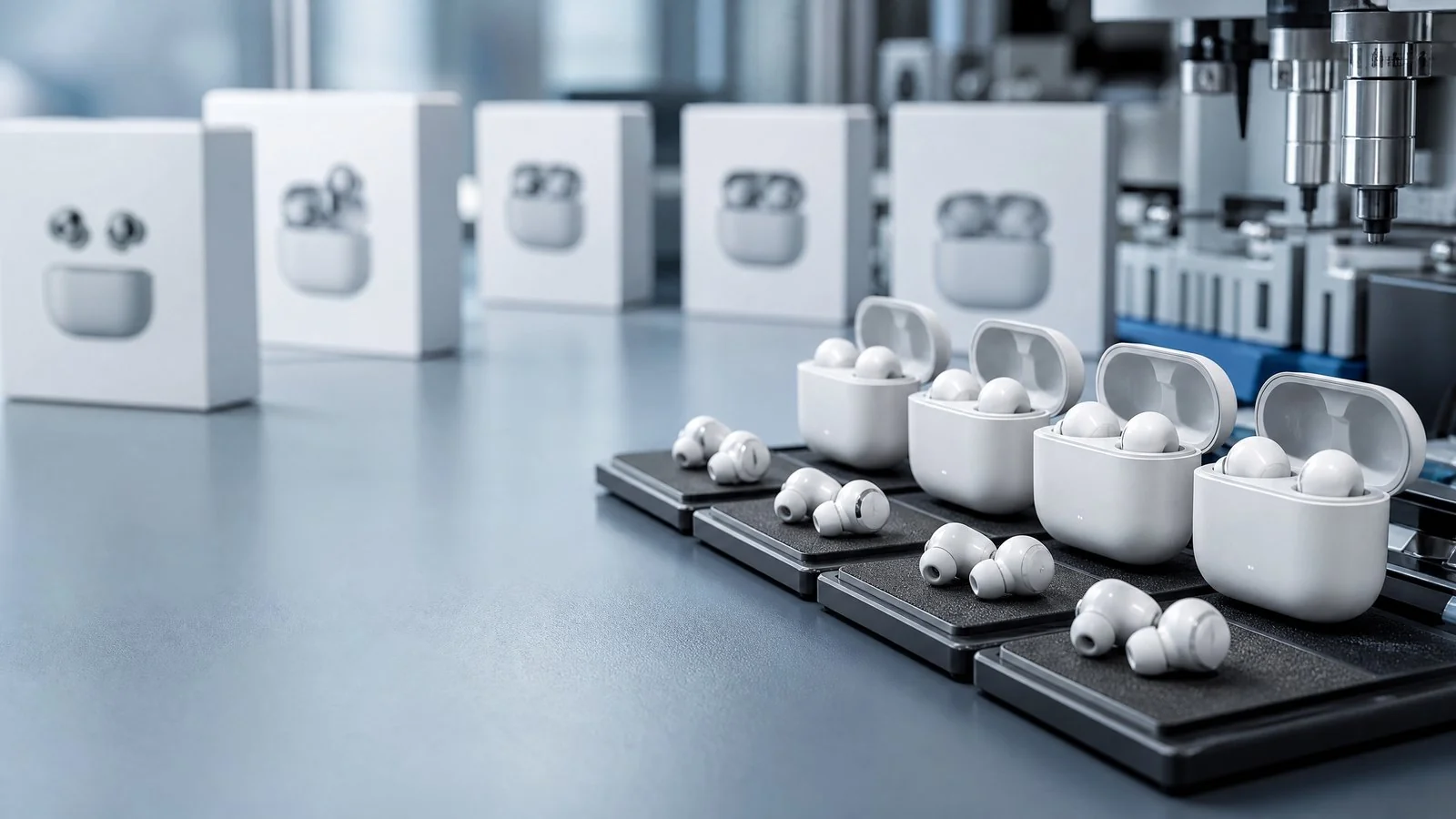
A professional TWS earphone factory follows a structured 12-stage manufacturing process that transforms raw components into a finished, certified product. The process begins with PCB assembly, where surface mount technology machines place Bluetooth SoCs, power management ICs, and passive components onto the printed circuit board with 0402-precision placement. Driver unit installation follows, with each speaker driver soldered to the PCB and acoustically sealed to the earbud housing. Battery placement is critical: the lithium-polymer cell, typically 30 to 50mAh for earbuds and 300 to 500mAh for the charging case, must be positioned to minimize electromagnetic interference with the driver while maximizing weight balance for ergonomic comfort.
Casing production uses precision injection molding with ABS, PC, or PC-ABS blends, depending on the target price tier and finish quality. Premium models may use dual-injection molding to combine a rigid shell with a soft-touch TPU coating. After assembly, each earbud undergoes pairing testing to verify stable Bluetooth connectivity and synchronized audio output between left and right channels. The charging case is tested for charging current, case-to-earbud contact reliability, and battery level reporting accuracy. According to IPC-A-610 Class 2 manufacturing standards, a properly managed TWS production line should achieve a first-pass yield rate above 96 percent.
Final quality control involves a battery of tests that simulate real-world abuse. Frequency response testing uses a specialized artificial ear measurement system to verify that each unit meets the target sound signature within plus or minus 3dB across the 20Hz to 20kHz range. Drop testing subjects earbuds to 1.5-meter free falls onto a hardwood surface from six orientations, with no functional damage permitted. Sweat testing exposes the earbuds to a 5 percent saltwater solution at 40 degrees Celsius for 4 hours to validate IPX water resistance claims. An experienced earphone OEM ODM partner like HousePlus documents every test result and provides batch-level quality reports, giving brand owners traceable confidence in product reliability.
4. OEM vs ODM: Which Manufacturing Model Fits Your Brand?
The distinction between OEM and ODM is the most consequential strategic decision in TWS earphones sourcing. OEM, or Original Equipment Manufacturer, means you select an existing factory design and apply your brand logo, packaging, and color scheme. The manufacturer holds the base product design, and you customize the exterior identity. This model offers the lowest MOQ, typically 500 pieces, the fastest time to market at 25 to 35 days, and the lowest upfront investment. It is ideal for brands launching their first TWS product line or testing market demand before committing to custom engineering. The trade-off is that competing brands may sell visually similar products from the same factory.
ODM, or Original Design Manufacturer, gives you full control over the product design, including driver selection, chipset platform, acoustic tuning, casing mold, and feature set. You own the intellectual property and the resulting product is unique to your brand. The ODM model requires a higher MOQ, typically 2,000 to 5,000 pieces, and a longer development cycle of 60 to 120 days for mold tooling, acoustic tuning, and prototype iteration. Upfront tooling costs range from 8,000 to 25,000 US dollars depending on casing complexity. However, ODM delivers superior margins, differentiated product positioning, and the ability to secure design patents. For brands with annual volumes above 20,000 units, ODM is almost always the more profitable long-term strategy.
5. Certifications and Regulatory Compliance for TWS Earphones
Certification compliance is non-negotiable for cross-border TWS earphone trade, and missing or invalid certificates are the single most common cause of customs seizures and Amazon listing suspensions. CE marking is mandatory for the European Economic Area and requires compliance with the Radio Equipment Directive (RED) 2014/53/EU, the EMC Directive 2014/30/EU, and the RoHS Directive 2011/65/EU. For the United States, FCC certification under Part 15B and Part 15C is required for all Bluetooth-emitting devices, and the FCC ID must be permanently affixed to the product. RoHS compliance restricts six hazardous substances including lead, mercury, and cadmium, while REACH regulation requires registration of chemical substances used in the product.
Bluetooth BQB certification, administered by the Bluetooth SIG, is a specific requirement that many new importers overlook. Any product using Bluetooth technology must complete BQB qualification listing, which validates that the product meets Bluetooth core specifications and interoperates with other certified devices. Selling Bluetooth products without BQB listing is a trademark violation that can result in legal action by the Bluetooth SIG and delisting from major e-commerce platforms. For the lithium-polymer batteries inside TWS earphones, UN38.3 testing supports transport safety and IEC 62133 relates to battery safety. For a HousePlus inquiry, request the documentation applicable to the exact model and destination before purchase.
6. Pricing Structures and MOQ for TWS Earphone Manufacturing
TWS earphone pricing follows a volume-driven tiered structure that rewards larger commitments with progressively lower unit costs. At the entry tier of 500 pieces, a standard Bluetooth 5.3 TWS earphone with ENC, 13mm driver, IPX4 rating, and 30-hour total playtime carries an FOB price of 7.50 to 9.50 US dollars per set. At 1,000 pieces, the price drops to 6.50 to 8.00 dollars. At 5,000 pieces, expect 5.00 to 6.50 dollars. At 10,000 pieces and above, the price stabilizes at 4.20 to 5.50 dollars. ANC-equipped models command a 2.50 to 4.00 dollar premium across all tiers due to the additional DSP chipset and multiple microphones required.
Understanding the component cost breakdown helps you negotiate effectively and identify where customization adds value. In a standard TWS earphone, the driver unit, Bluetooth SoC chipset, batteries, casing, PCB, assembly and packaging are important cost categories. When evaluating quotations, ask the supplier to clarify the applicable specifications, component choices, Incoterm, documentation and quality controls. For a HousePlus inquiry, these items are reviewed for the exact proposed order.
Conclusion: Building a Successful TWS Earphone Brand
Building a profitable TWS earphone brand in 2026 demands more than finding the cheapest supplier on a B2B marketplace. Success requires a systematic approach: selecting the right Bluetooth chipset and codec combination, specifying driver units and acoustic tuning that match your target audience, implementing robust ANC and ENC functionality, navigating the full certification landscape from CE and FCC to BQB and IEC 62133, and negotiating pricing structures that reflect genuine component costs rather than artificially deflated quotes. Whether you choose the OEM path for speed and low MOQ or the ODM path for differentiation and IP ownership, the manufacturer you select determines your product quality, certification compliance, and ultimately your brand reputation.
For a HousePlus TWS-earphone inquiry, share the target specifications, destination market, branding requirements and order configuration. Our team can discuss available models, samples, product-specific documentation, OEM/ODM scope and quotation terms after reviewing your request. Contact Jack at jack@houseplus-ch.com or +86-155-7811-9543 (WhatsApp: +8615578119543) to begin the review.
Request a Wholesale Quote from HousePlus
Contact our team to discuss product requirements, OEM/ODM capabilities, applicable documentation and quotation terms.
Contact HousePlus