
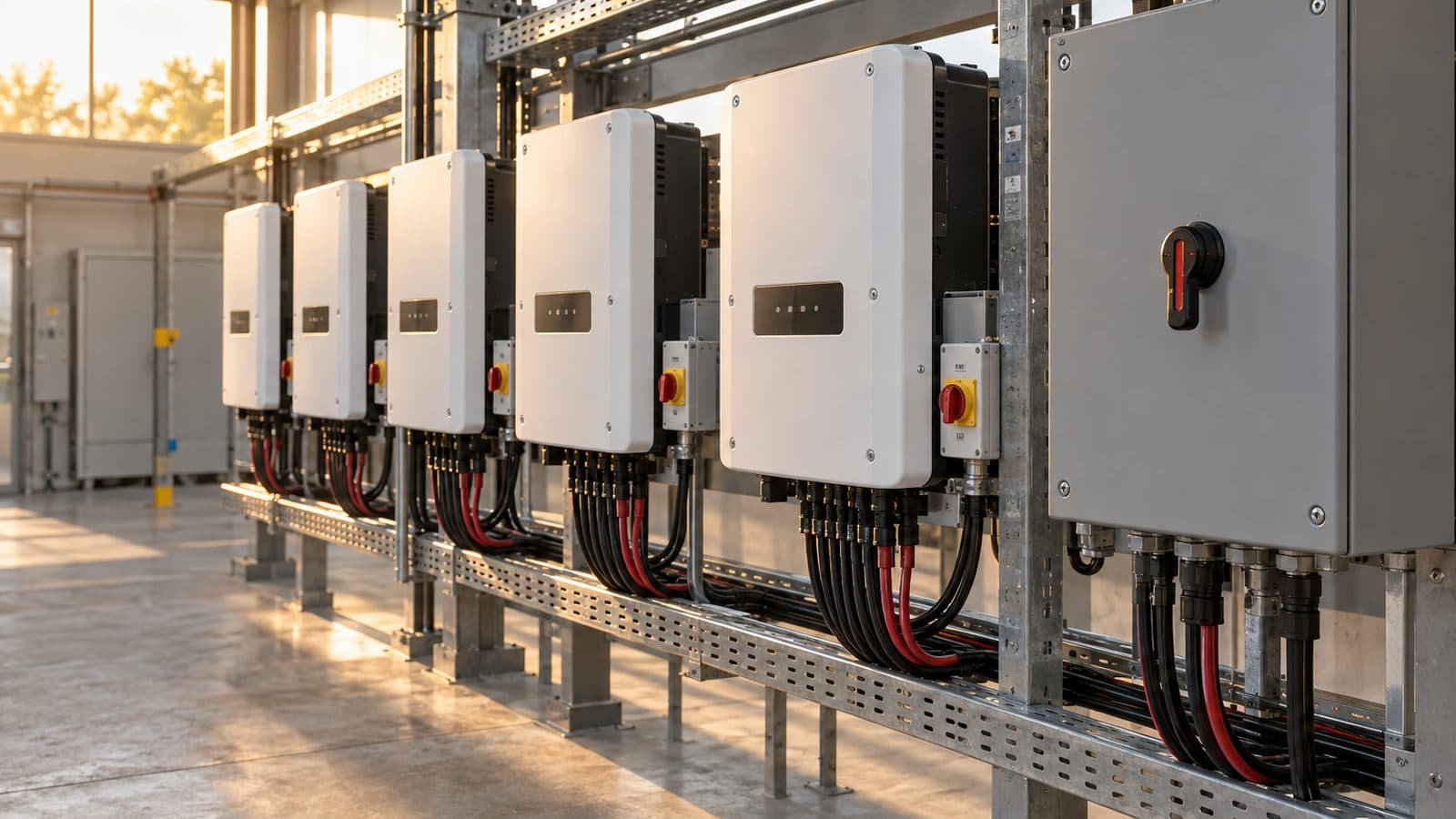
Why the Inverter Decides Whether a Solar Order Succeeds
Panels get the attention, but the inverter is the component most likely to generate a warranty claim. It is the only part of a solar system that works continuously under load, it carries the firmware that determines grid behaviour, and it is the part a customs officer or utility inspector is most likely to question when you import a container into a regulated market.
For a wholesale buyer, inverter selection therefore has to be made on two axes at once: the technical fit for the projects your customers actually build, and the paperwork trail that lets those projects pass inspection. Getting the second one wrong turns a profitable order into a stalled shipment, even when the hardware itself is sound.
This guide covers the criteria that matter when you are specifying inverters for resale rather than for a single installation, and the questions worth putting to a manufacturer before you commit to a first container.
1. Match the Inverter Topology to Your Customer Base
String inverters remain the volume product for residential and small commercial work. They are the cheapest per kilowatt, the simplest to stock, and the easiest to service because a single unit serves a whole array. If your customers are residential installers, string inverters should be the core of your range.
Hybrid inverters add battery inputs and an energy management layer, which lets them serve self-consumption and backup projects without a separate battery inverter. They carry a higher unit cost but a much higher margin, and they are the natural companion to the LFP storage systems that increasingly appear in residential tenders.
Microinverters and power optimisers sit at the other end: highest cost per watt, but they solve shading and rapid-shutdown requirements that string inverters cannot. Stock them as a specialist line for markets where module-level shutdown is mandated, not as a general-purpose product.
2. Read the Efficiency Curve, Not the Peak Efficiency Figure
Every inverter datasheet quotes a peak efficiency, usually a number between 97% and 98.5% for a modern transformerless unit. That number describes one operating point. What matters commercially is the European or CEC weighted efficiency, which averages performance across the partial-load range where real systems spend most of their time.
A unit with 98.2% peak efficiency but a weak partial-load curve can underperform a 97.8% unit across a real year of operation. Ask for the weighted efficiency figure and, if it is available, the efficiency curve itself. This is also a useful quality signal: manufacturers who can produce the curve are usually the ones who measured it.
3. Confirm MPPT Count, Voltage Window and Oversizing Ratio
The number of MPPT trackers determines how many differently oriented or partially shaded sub-arrays the inverter can manage independently. Two trackers is the practical minimum for residential work; three or more is expected once you move into commercial roofs with mixed orientations.
Check the DC input voltage window against the module strings your customers build, and confirm the maximum DC input power. Modern designs tolerate an oversizing ratio of 1.2 to 1.3 without clipping losses that matter, and that headroom lets installers add panels later. A manufacturer who cannot state the recommended oversizing ratio for their own product has not tested it.
4. Verify Grid-Code and Safety Certification for Each Target Market
An inverter is a grid-interactive device, so it is regulated differently from a solar panel. CE marking alone is not sufficient for grid connection. For Europe you need the relevant grid code declaration for the destination country, plus EN 50549 or the local equivalent; for North America, UL 1741 with the appropriate supplement; for Australia, AS/NZS 4777.2 and Clean Energy Council listing.
Before placing a wholesale order, ask for the certificates by destination market rather than a general compliance statement, and verify the certificate numbers against the issuing body. This is the single most common reason a container of otherwise good inverters cannot be sold into a specific country.
5. Commercial Terms: MOQ, Warranty and Firmware Support
Inverter MOQs are usually lower than panel MOQs because the units are smaller and higher value. Expect standard terms to start around 100 units, with OEM branding, custom packaging and firmware parameter sets available at higher volumes. Clarify whether the warranty is handled by replacement unit, by repair, or by credit, because the logistics differ substantially.
Firmware matters more than most buyers expect. Grid codes are revised, and an inverter that cannot accept an updated parameter set becomes unsellable in that market. Ask how firmware is distributed, whether a local installer can apply it without the factory, and how long the manufacturer commits to providing updates.
6. What to Put in the First Order
For a first container, a balanced range usually works better than depth in one model. A typical mix pairs one high-volume string inverter size, one hybrid unit in the most common residential power class, and a small quantity of an MPPT charge controller for off-grid work, which lets you serve several customer types without tying up capital in a single SKU.
Request samples of each candidate model, test them against the datasheet claims, and confirm the documentation package that ships with production units: manual, certificate copies, and the declaration of conformity your customer will need at inspection.
Demandez un devis de gros à HousePlus
Contactez notre équipe pour discuter des exigences produit, des capacités OEM/ODM, de la documentation applicable et des conditions du devis.
Contacter HousePlus