
Why Choosing the Right Wholesale Solar Panel Supplier Matters
Sourcing solar panels at wholesale prices is one of the most consequential procurement decisions a solar distributor, EPC contractor, or renewable energy reseller will make in 2026. With global solar capacity expected to surpass 2 terawatts and panel prices continuing to decline, the opportunity for margin growth has never been greater. However, choosing the wrong wholesale solar panel supplier can lead to certification failures, delayed shipments, underperforming modules, and reputational damage with your end customers.
This comprehensive buyer’s guide walks you through every critical factor to evaluate when selecting a wholesale solar panel manufacturer, from cell technology and efficiency ratings to certifications, OEM/ODM capabilities, minimum order quantities, warranty terms, and international logistics. Whether you are importing your first container or scaling to multi-megawatt annual volume, these evaluation criteria will help you make a confident, data-driven decision.
1. Understand the Three Core Solar Panel Technologies
The first decision when buying wholesale solar panels is choosing the right cell technology. Monocrystalline solar panels dominate the 2026 market because their single-crystal silicon structure delivers the highest efficiency, typically between 20% and 23%. They occupy less space per watt, perform better in high temperatures, and offer a sleeker aesthetic preferred by residential customers.
Polycrystalline panels, made from multiple silicon fragments melted together, are cheaper to produce but achieve lower efficiency of 15% to 18%, making them suitable for budget-sensitive commercial projects with ample mounting space. Thin-film panels, including CdTe and CIGS variants, are lightweight and flexible but generally less efficient, so they are reserved for specialised applications such as curved surfaces or portable solar products. For most wholesale buyers, monocrystalline panels offer the best balance of performance, price per watt, and market demand.
2. Evaluate Efficiency Ratings and Power Output
Efficiency determines how much electricity a panel generates from a given area of sunlight. Higher efficiency means more watts per square metre, which directly lowers your balance-of-system costs because you need fewer panels, less mounting hardware, and reduced installation labour.
When comparing wholesale solar panel quotes, always request the module efficiency percentage alongside the rated peak power (Pmax). A modern 500W monocrystalline panel with 21.5% efficiency will outperform an older 450W panel at 19% efficiency across the system lifetime. Also examine the temperature coefficient, which measures how much output drops as the panel heats up. A lower coefficient, such as minus 0.35% per degree Celsius, preserves energy harvest in hot climates.
3. Verify Certifications and Regulatory Compliance
Certifications are non-negotiable for cross-border solar trade. At minimum, your wholesale solar panels must carry CE marking for the European market, RoHS compliance for restricted hazardous substances, and IEC 61215 design qualification plus IEC 61730 safety qualification. These international standards confirm that the panels have passed thermal cycling, humidity-freeze, mechanical load, and insulation tests.
If you target the United States, confirm UL 1703 or UL 61730 listing; for Australia, look for Clean Energy Council (CEC) approval. Always request digital copies of the actual certificate PDFs, not just a supplier’s claim, and cross-check the certificate number against the issuing body’s online database. Buying uncertified panels risks customs seizure, project rejection, and liability for property damage.
4. Assess Manufacturer Capabilities and OEM/ODM Options
The strength of your wholesale partner’s factory determines product consistency and your ability to offer a private-label brand. Visit or request a virtual tour of the manufacturing facility to confirm vertical integration, meaning the supplier controls PCB design, cell sorting, stringing, lamination, framing, and final testing under one roof.
A vertically integrated manufacturer with 20,000 square metres of factory space and 500 or more employees can maintain tighter quality control and shorter lead times than a trading company that outsources every step. If you plan to build your own brand, confirm OEM and ODM services: logo printing on frames and junction boxes, custom packaging design, and flexible MOQs starting around 500 pieces for customised orders.
5. Compare Pricing Structures and Minimum Order Quantities
Wholesale solar panel pricing is quoted per watt or per piece and decreases with volume. Always request a tiered price list showing unit cost at 100, 500, 1,000, and full-container quantities so you can forecast margins accurately. The minimum order quantity typically starts at 100 pieces for standard stock panels and rises to 500 pieces for OEM or ODM customisation.
Clarify whether the quoted price is EXW (ex-works), FOB (free on board), or CIF (cost, insurance, and freight), since this materially changes your landed cost. Beware of prices that seem too good to be true; they often indicate B-grade cells, omitted certifications, or substitution of inferior materials after the sample approval stage.
6. Review Warranty Terms and After-Sales Support
A robust warranty signals manufacturer confidence in product durability. Industry-standard terms include a 12-year product warranty covering manufacturing defects and a 25-year linear power output guarantee ensuring at least 80% to 84% of rated power at year 25. Ask the supplier to provide the actual warranty document and clarify the claims process.
For large orders, negotiate extended 18 to 24-month product warranty coverage. Equally important is after-sales responsiveness: confirm the supplier’s average reply time, their RMA (return merchandise authorisation) turnaround, and whether they maintain English-speaking technical support across your time zone.
7. Factor In Logistics, Packaging, and Lead Times
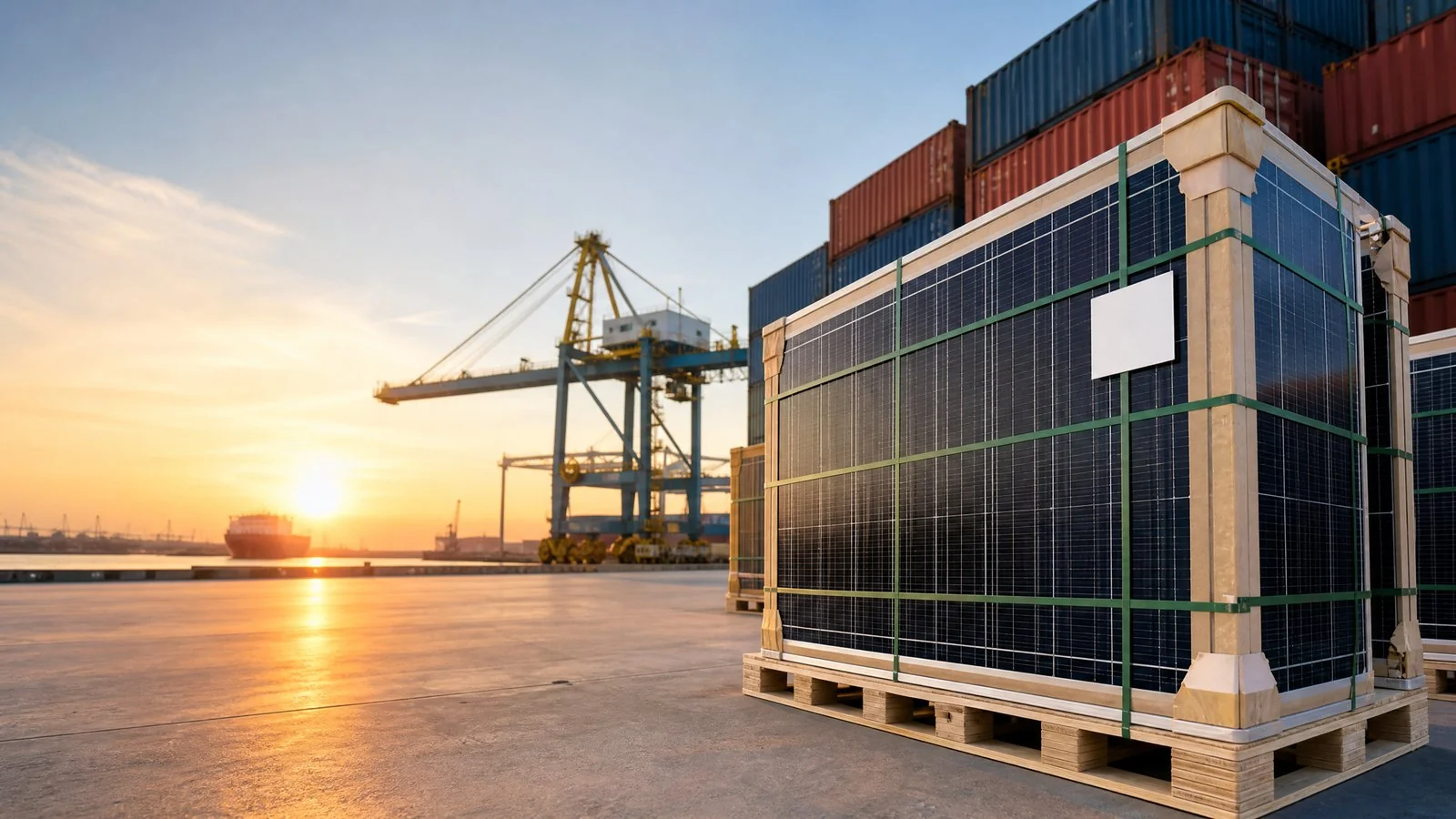
International solar shipping requires careful planning to control cost and avoid damage. Standard production lead time ranges from 20 to 35 days from order confirmation, extending to 45 to 60 days for OEM or ODM orders requiring tooling. Panels are packed vertically, typically two per carton with foam corner protectors, and palletised at 26 to 30 panels per pallet.
A 40-foot high-cube container holds roughly 600 to 650 panels, which is the most cost-efficient shipping unit. Choose sea freight for bulk orders and express courier for samples. Confirm the supplier supports both FOB and EXW incoterms and can provide export documentation, including commercial invoices, packing lists, certificates of origin, and bill of lading.
Conclusion: Build a Long-Term Wholesale Partnership
Choosing wholesale solar panels is not a one-time transaction but the foundation of a long-term supply partnership. By systematically evaluating cell technology, efficiency, certifications, manufacturing depth, pricing tiers, warranty strength, and logistics, you reduce procurement risk and build a defensible competitive position in your market.
Start by requesting samples from two or three shortlisted manufacturers, test them under real conditions, and compare the documentation rigorously. The right wholesale solar panel supplier will not only deliver compliant, high-yield modules but also grow with you as the global solar market expands through the rest of this decade. Contact HousePlus today to request samples and a tiered wholesale quotation.
Request a Wholesale Quote from HousePlus
Contact our team to discuss product requirements, OEM/ODM capabilities, applicable documentation and quotation terms.
Contact HousePlus