
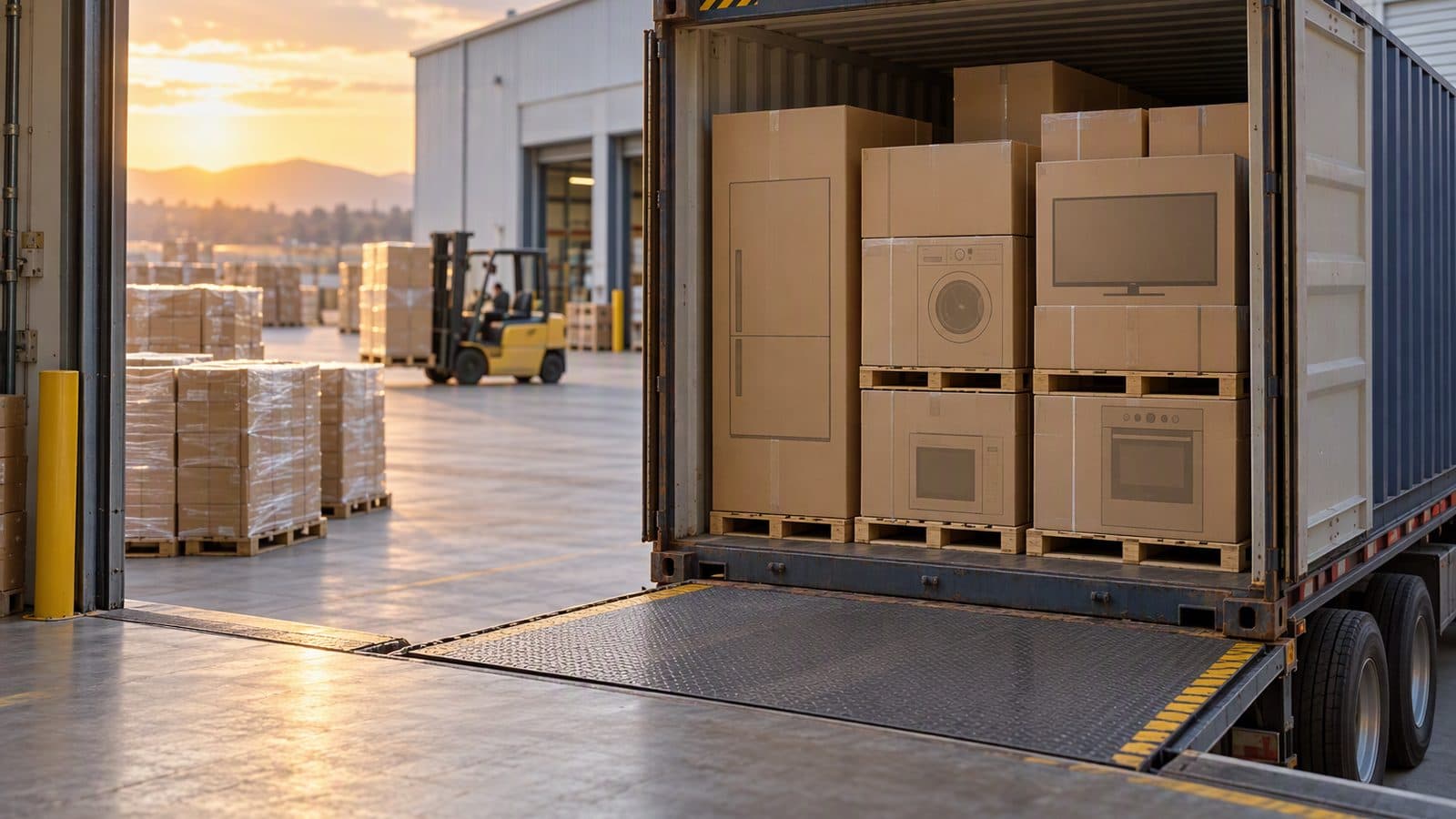
Why Loading Efficiency Is a Margin Decision, Not a Logistics Detail
Freight is charged on the container, not on the number of units inside it. That single fact means every cubic metre of empty space in a shipment is money you have already spent and cannot recover. Two buyers can import the same appliance at the same ex-works price and land it at noticeably different unit costs purely because of how the cartons were packed.
Loading efficiency is therefore a purchasing decision. It belongs in the same conversation as unit price and payment terms, and it should be settled before the order is confirmed rather than left to whoever loads the truck at the factory.
1. Understand What a Container Actually Holds
A 20ft container holds roughly 28 to 33 cubic metres of usable volume and a 40ft container roughly 58 to 67, depending on whether it is a standard or high-cube unit. The gap between the low and high figure is not trivia: it is the difference between loading to the door and leaving several cubic metres of paid space empty.
Weight is the other constraint, and for dense products it binds first. Many appliances and batteries reach the road weight limit before the container is volumetrically full. When that happens, adding more units is impossible regardless of remaining space, so the only lever left is reducing packaging volume per unit.
2. Treat Carton Dimensions as a Negotiable Specification
Carton dimensions are frequently inherited rather than designed. A carton sized to fit a product with generous foam clearance can often be reduced by several centimetres without reducing protection, and because container capacity is a function of stacked layers, small reductions multiply across the load.
When you request a quote, ask for the carton dimensions and the units per carton, then calculate the theoretical container quantity yourself. A supplier who can supply a loading plan alongside the quotation is signalling that they have actually packed the product, which is a useful competence check in its own right.
3. Decide Between Palletised and Floor Loading
Palletised loading is faster to handle at destination, reduces manual handling damage, and is often required by warehouses with automated racking. It also costs volume: pallets and the clearance needed to lift them typically consume 10 to 15 percent of the container.
Floor loading recovers that volume but shifts the handling burden to the receiving warehouse and demands tighter stacking discipline. For small appliances with strong cartons, floor loading frequently wins on cost. For heavy or fragile units, the pallet is usually worth the space it costs.
4. Plan Mixed SKUs Deliberately
Mixed containers let a distributor test several products without committing to a full load of each, which is exactly what a new market entry needs. The risk is that mixed loads are usually planned last, after the easy full-SKU loads, and end up with the awkward remainders.
Plan the mix around carton geometry rather than around product categories. SKUs whose cartons share a footprint stack cleanly together; mixing a tall narrow carton with a wide flat one wastes the gap between them. Ask for a loading diagram and check that the plan accounts for the last layer, which is where waste concentrates.
5. Lock Down the Terms and the Paperwork
Confirm the Incoterm before the loading plan is fixed, because it determines who owns the risk at each stage. FOB leaves the main carriage to you; CIF and DDP put it on the supplier but usually at a higher quoted price that already includes the freight. Comparing quotes across different Incoterms without normalising them is one of the most common costing errors in wholesale importing.
Ask for photographs of the loaded container, the packing list, and the container seal number before the unit leaves the factory. This documentation is what settles a damage claim, and it costs the supplier nothing to provide. A supplier who resists is telling you something about how the claim will go.
اطلب عرض أسعار بالجملة من HousePlus
تواصل مع فريقنا لمناقشة متطلبات المنتج وقدرات OEM/ODM والوثائق المطلوبة وشروط عرض الأسعار.
تواصل مع HousePlus