
Why GaN Chargers Sell on Specification, Not on Wattage
Gallium nitride chargers have moved from a premium curiosity to a mainstream category in a few product cycles, largely because the technology lets a small enclosure deliver power that previously required a much larger brick. The consequence for a wholesale buyer is that the market now contains a wide spread of products that all advertise similar wattage while differing substantially in what they actually deliver.
The differences are not visible on a shelf. They show up when a customer plugs in a laptop and a phone at the same time, when a device negotiates a fast-charge protocol the charger does not fully support, or when the unit runs warm enough to throttle. Those are the returns, and they are determined by specifications you can check before ordering.
1. Understand What the Wattage Number Hides
A charger rated at 65W rarely delivers 65W to every port. In a multi-port design the total output is shared, and the allocation depends on which ports are in use. A unit that supplies 65W to a single port may drop to 45W plus 20W when a second device is connected, or lower still with three.
Ask for the full power allocation table across every port combination, not just the headline figure. This single document separates products that will satisfy customers from products that will generate support tickets, and suppliers who design their own hardware can produce it immediately.
2. Confirm Protocol Support, Especially PPS
USB Power Delivery is the baseline, but the detail that matters is which revision and which optional features are implemented. Programmable Power Supply, or PPS, is the piece that enables fast charging on a large share of Android handsets, and it is frequently omitted from cheaper designs because it requires tighter voltage regulation.
Also confirm the supported voltage and current steps, and whether the charger handles the higher-voltage fixed PDOs needed for laptops. A charger that lists USB PD but not PPS will still charge most devices slowly, which customers read as a defective product rather than as a specification gap.
3. Treat Thermal Design as the Real Engineering Differentiator
GaN devices switch more efficiently than silicon, which is why the enclosures are small. That advantage is easily spent: a compact enclosure with inadequate thermal path will run hot, and a hot charger derates its output to protect itself. The customer experience is a charger that starts fast and then slows down.
Ask for the surface temperature at rated load in a defined ambient condition, and for the derating behaviour. A supplier who can quote both has measured them. Confirm as well that the thermal design does not rely on the user handling a hot surface, since surface temperature limits are a safety requirement as well as a comfort issue.
4. Verify Safety Certification and Its Scope
Chargers are subject to safety standards for audio, video, information and communication technology equipment, and the certification must cover the specific model rather than the product family in general. Confirm the certificate names the model number you are ordering.
Alongside the safety standard, check the electromagnetic compatibility evidence and, for markets with energy efficiency requirements, the no-load power consumption figure. For European sales the charger also needs the appropriate CE documentation, and for North America the relevant listing. Request the certificate copies rather than a compliance statement.
5. Specify the Mechanical and Cable Details Before Ordering
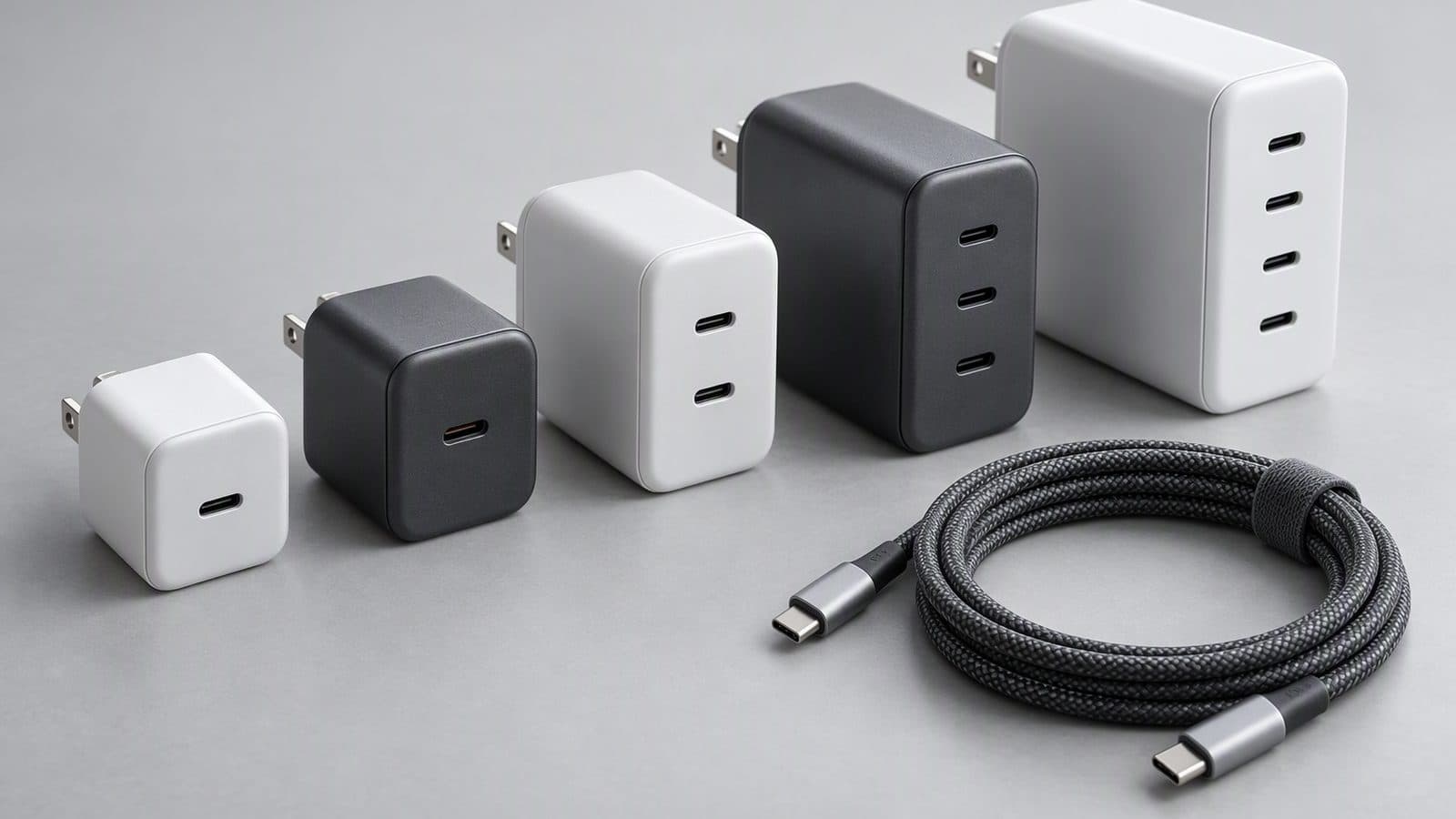
The details that drive returns in this category are mechanical. Confirm the plug type and whether interchangeable or folding pins are used, since these determine which markets the same SKU can serve. Confirm the port count and orientation, and check that the enclosure finish does not show handling marks after a few weeks of use.
If the charger ships with a cable, treat the cable as part of the specification rather than an accessory. A charger capable of 65W paired with a cable rated below that figure will not deliver its rated power, and the customer will blame the charger. Specify the cable current rating and confirm it carries the electronic marking required for higher-power USB-C operation.
6. Ordering Terms for Charger Programmes
Charger MOQs are typically lower than appliance MOQs, which makes a mixed first order across wattage classes practical: a 30W class for phone-led markets, a 65W class as the volume seller, and a 100W or higher class for laptop users. Confirm whether the MOQ applies per wattage class or per order.
Because this category moves quickly, agree on how specification changes are communicated. A supplier that substitutes a lower-cost component between production runs changes the product you qualified, and in chargers that substitution is often invisible until a customer notices slower charging.
اطلب عرض أسعار بالجملة من HousePlus
تواصل مع فريقنا لمناقشة متطلبات المنتج وقدرات OEM/ODM والوثائق المطلوبة وشروط عرض الأسعار.
تواصل مع HousePlus